How much protein do men actually need?
Protein needs for men by weight, training and age, with daily ranges, meal distribution evidence, food sources and kidney cautions.

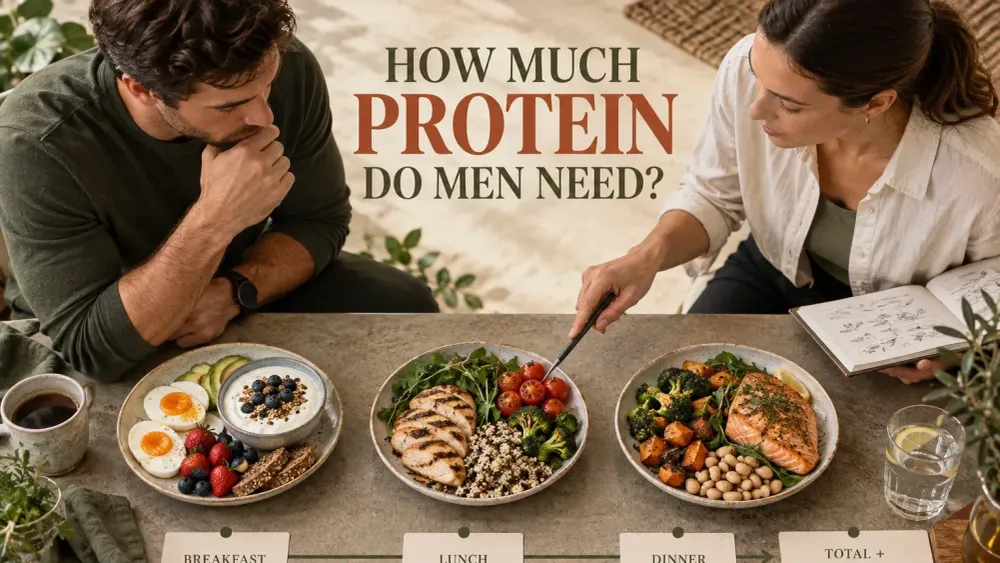
The U.S. and Canadian adult RDA is 0.8 g/kg/day. It is designed to cover nearly all healthy adults, not to define the amount that maximizes gains from resistance training. The EFSA adult reference is similar at 0.83 g/kg/day.
Training, age and energy restriction can justify different planning ranges. Those are goal- and population-specific recommendations rather than proof that the adult RDA is merely a deficiency threshold.
The numbers that match your goal
| Your situation | Daily protein | For an 85 kg man |
|---|---|---|
| General health, little training | 0.8 g/kg (adult RDA) | About 70 g |
| Active, keeping the muscle you have | 1.2–1.6 g/kg | 100–135 g |
| Training to build muscle | 1.6–2.0 g/kg | 135–170 g |
| Energy deficit | Depends on leanness, deficit size and resistance training; do not apply athlete ranges universally | Individualize from the relevant adult or training range |
| Over 65, not especially active | At least 1.0–1.2 g/kg | 85–100 g |
| Over 65 and training | At least 1.2 g/kg, often more | 100 g and up |
The International Society of Sports Nutrition considers 1.4 to 2.0 g/kg/day sufficient for most exercising adults. This is sports-nutrition guidance, not a universal requirement for every adult.
Where the returns become uncertain
A meta-analysis of 49 resistance-training studies and 1,863 participants estimated a modeled breakpoint near 1.62 g/kg/day, with a wide 95% confidence interval of 1.03 to 2.20 g/kg/day. It is not a universal requirement, ceiling or safety limit; it describes where additional average benefit became difficult to detect in that dataset.
For an 85 kg man, 1.6 g/kg is about 136 g and 2.0 g/kg is 170 g. Evidence during an energy deficit depends on leanness, deficit size, resistance training and whether intake is scaled to body weight or fat-free mass. Higher recommendations from lean, resistance-trained athletes should not be generalized to every person losing weight.

How to spread it across the day
Total daily intake and resistance training matter most. Spreading protein can be practical, but long-term evidence that an equal distribution adds muscle beyond an adequate daily total is mixed.
About 0.25 to 0.4 g/kg per meal, often 20 to 40 g, every three to four hours is a practical heuristic rather than a mandatory rule.
Use defined portions rather than assuming every item supplies the same amount. For example, a cooked 100 g chicken breast or salmon portion commonly supplies roughly 20 to 30 g; three large eggs supply closer to 18 to 20 g; yogurt, lentils and cheese vary substantially by serving and product. Check the label or food database when the number matters.
Timing around training is a smaller lever than total daily intake. A 2025 direct-comparison meta-analysis found no important lean-mass difference between pre- and post-workout protein. A convenient meal near training is reasonable, but there is no narrow mandatory window.
After 65, guidance usually recommends more
For adults over 65, the PROT-AGE expert group recommends 1.0 to 1.2 g/kg/day for many healthy older people, at least 1.2 g/kg/day for active older adults, and 1.2 to 1.5 g/kg/day during many illnesses. These are optimization recommendations, not the official population RDA, and CKD, dialysis, frailty and sarcopenia require individual targets.
Protein alone will not hold muscle in place. It works when there is a training stimulus for it to support, which is the argument made in our guide to muscle loss with age.
The kidney question
Trials in adults without chronic kidney disease generally have not shown a worse short- or medium-term change in kidney function with higher protein intakes, but they do not establish unlimited or decades-long safety at very high intake.
Kidney disease is different. KDIGO 2024 commonly uses 0.8 g/kg/day for adults with CKD G3 to G5 and advises adults at risk of progression to avoid more than 1.3 g/kg/day. Dialysis, frailty and sarcopenia can change the target, so use clinician or renal-dietitian guidance.
The more realistic downsides of a very high protein diet are dull ones. It crowds out fiber and carbohydrate, it costs money, and it is hard to sustain, which matters more than any theoretical risk.

Food first, powder second
Protein powder is a convenience, not a requirement. It is useful when you cannot get a meal in, appetite is low, or you are short by 20 or 30 g at the end of the day. When total amount and protein quality are comparable, a powder is not inherently better for muscle outcomes; its advantages are convenience, predictable dosing and sometimes appetite tolerance. Creatine answers a different question and has its own evidence base.
Whey is convenient and leucine-rich, but it is not required. Adequately dosed soy, pea, blended plant proteins and mixed plant diets can support comparable strength and absolute lean-mass outcomes when total protein and essential amino acids are adequate.
These general bands apply to healthy adult men. Under-18s and people who are pregnant or breastfeeding, have CKD, serious liver disease, an eating disorder or a clinician-prescribed diet need individualized advice rather than a generic calculator target.
What food quality buys you is everything that comes attached. Harvard's nutrition team makes the point that the source matters as much as the amount, favoring fish, poultry, beans, nuts and legumes over red and processed meat.

What to do this week
- Work out your range. Use 0.8 g/kg as the general adult reference intake, 1.0–1.2 g/kg if you are over 65, and roughly 1.4–2.0 g/kg if you train regularly. Our protein calculator multiplies your weight by a self-selected general planning band; it does not measure training load.
- Count one ordinary day. Most men find the total is acceptable and the timing is not.
- Fix breakfast and lunch first. Getting 25 to 30 g into each of those is usually the whole gap.
- Do not turn one estimate into a ceiling. Around 1.6 g/kg is a sensible anchor; needs and study uncertainty extend above it, while more is not automatically better.
- Train. Protein supports muscle. Resistance training is what asks for it.
Frequently asked questions
How much protein does a man need per day?
The adult RDA is 0.8 g/kg/day and is designed to cover nearly all healthy adults. For most exercising adults, the ISSN considers 1.4 to 2.0 g/kg/day sufficient. A resistance-training meta-analysis estimated a modeled breakpoint near 1.62 g/kg/day with a wide 95% confidence interval of 1.03 to 2.20; those values are not universal requirements, ceilings or safety limits.
Is 200 g of protein a day too much?
Convert it by body weight and context. For a 90 kg man, 200 g is about 2.2 g/kg, above the 1.4 to 2.0 g/kg range considered sufficient for most exercising adults. No established adult upper limit does not mean unlimited intake is proven safe, and long-term evidence at very high intakes is limited. Medical conditions and prescribed diets can require much lower or different targets.
Does high protein damage your kidneys?
Short- and medium-term trials in adults without CKD generally have not shown a worse change in kidney function, but they do not prove unlimited long-term safety. KDIGO 2024 commonly uses 0.8 g/kg/day for CKD G3 to G5 and advises people at risk of progression to avoid more than 1.3 g/kg/day; dialysis, frailty and sarcopenia need individualized targets.
Do older men need more protein or less?
For many adults over 65, the PROT-AGE expert group recommends 1.0 to 1.2 g/kg/day, and at least 1.2 g/kg/day for active older adults. These are optimization recommendations rather than the official adult RDA. CKD, dialysis, frailty, sarcopenia and illness can change the target, so individual guidance matters.
Read next

The Mifflin-St Jeor equation: the formula, and how accurate it is
A formula used by many calorie calculators: what it estimates, where accuracy varies, and how to compare the result with a multi-week trend.

Foods and testosterone: what your diet really changes
No single food reliably boosts testosterone. See what evidence says about excess weight, dietary fat, alcohol, soy, zinc and vitamin D.