Foods and testosterone: what your diet really changes
No single food reliably boosts testosterone. See what evidence says about excess weight, dietary fat, alcohol, soy, zinc and vitamin D.

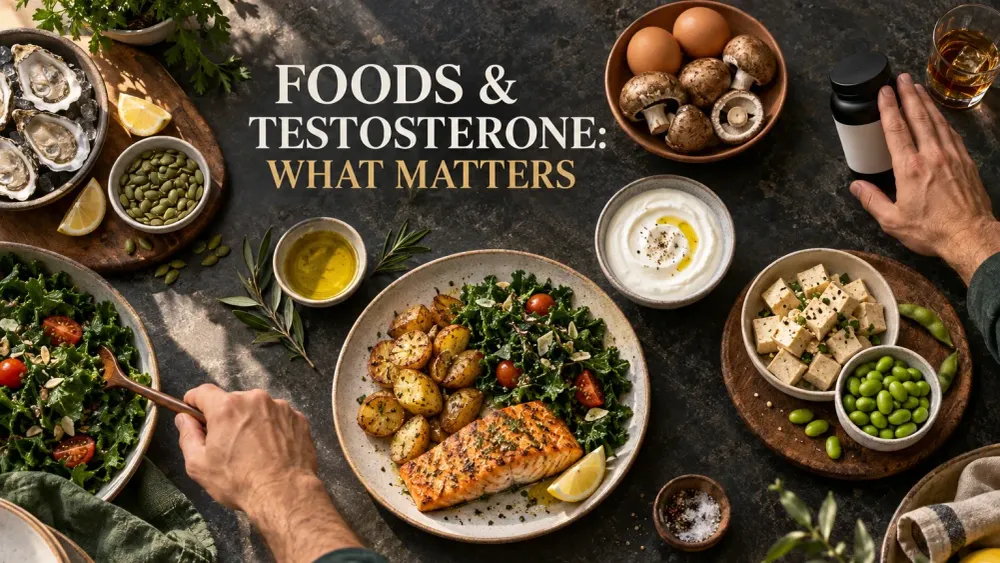
No single food reliably raises testosterone in a clinically meaningful, sustained way. Oysters, eggs, red meat, garlic and pomegranate can all fit into a nutritious diet, but human evidence does not support treating any of them as a testosterone therapy.
Diet still matters. The strongest dietary signal is indirect: losing excess weight can raise testosterone in men with obesity, while chronic under-fuelling can work in the opposite direction. Dietary fat, alcohol, soy and nutrient deficiencies matter in narrower and less dramatic ways.
The biggest dietary lever is excess weight
In men with obesity, low total testosterone can partly reflect lower sex hormone-binding globulin, and more severe obesity can also suppress signalling along the hypothalamic-pituitary-testicular axis. This is one reason a low result should be interpreted with symptoms, repeat testing and the wider clinical picture rather than treated as a diagnosis on its own.
A systematic review and meta-analysis found that low-calorie diets producing mean weight loss of about 10% were associated with an average total-testosterone rise of 2.87 nmol/L, roughly 83 ng/dL. Bariatric surgery produced greater weight loss and a larger average rise. The response was larger in people who lost more weight, but these figures are group averages and do not promise the same hormone or symptom change for every man (European Journal of Endocrinology, 2013).
When obesity is contributing and no other cause has been identified, sustained weight loss is usually the sensible first intervention. That does not require a named diet. It requires an eating pattern that creates a manageable deficit, preserves muscle and can be maintained. Our guide to raising testosterone naturally puts diet beside sleep, exercise and medical assessment.
Eating too little can also lower testosterone
The useful message is not “eat less at any cost.” Low energy availability occurs when intake is too low for training demands and normal physiology after exercise expenditure is considered. It is best documented in athletes, including men, and can affect reproductive function, bone health, recovery and performance.
The International Olympic Committee includes male athletes in its consensus on Relative Energy Deficiency in Sport, and reviews of male endurance and track-and-field athletes report lower testosterone and libido among the possible consequences of prolonged low energy availability (British Journal of Sports Medicine, 2023; European Journal of Translational Myology, 2023; International Journal of Sport Nutrition and Exercise Metabolism, 2019).
This does not mean every calorie deficit lowers testosterone. For a man with obesity, a moderate deficit that produces sustainable weight loss may improve hormone levels. The concern is prolonged under-fuelling, especially with high training loads, very low body fat, declining performance, recurrent injury, reduced libido or unexplained fatigue. Weight stability does not always rule it out because the body can adapt to chronic low availability.
Dietary fat: mixed and low-certainty evidence
An earlier meta-analysis pooled six intervention studies involving 206 men. Low-fat diets were associated with slightly lower total testosterone than higher-fat diets, with a standardized mean difference of -0.38. The authors said more randomized trials were needed (Journal of Steroid Biochemistry and Molecular Biology, 2021).
A broader 2025 meta-analysis of 11 randomized trials and 888 participants found no statistically significant difference in testosterone between low-fat and higher-fat diets. Its authors rated the evidence as low certainty because the number of studies remained small (Journal of Food Science, 2025).
Observational data do not settle the question. In NHANES data from 3,128 US men, mean testosterone was 410.8 ng/dL among men reporting a low-fat diet and 443.5 ng/dL among those reporting a nonrestrictive diet. The association persisted after adjustment for several measured factors, but a cross-sectional study cannot show that the diet caused the difference (The Journal of Urology, 2020).
There is no reliable evidence here that a high-fat diet produces a clinically meaningful, lasting testosterone benefit. Avoid extreme restriction, include unsaturated fats, and judge the whole eating pattern by cardiovascular health, energy intake and sustainability.
Soy does not lower testosterone
The soy myth has been tested in clinical studies. An updated meta-analysis included 41 studies and found no effect of soy protein or isoflavones on total testosterone, free testosterone, estradiol or estrone in men. Results did not change when researchers considered dose or study duration (Reproductive Toxicology, 2021).
Tofu, tempeh, edamame and soy milk can be useful protein foods. If you tolerate and enjoy them, testosterone is not a reason to avoid them.
Chronic heavy alcohol use can matter
A meta-analysis of 21 studies covering 30 trials and 10,199 participants linked alcohol exposure overall with lower total and free testosterone. The authors found that the result was evident in healthy men exposed to chronic consumption, not after acute intake, and they said the exact mechanisms remain incompletely understood (Andrology, 2024).
That finding does not define a precise threshold at which one drink changes a man's hormones. The practical concern is chronic or high intake. Cutting back has a stronger rationale when intake is heavy, and the wider benefits do not depend on proving a specific testosterone increase.
Zinc and vitamin D: correct deficiencies, do not chase boosts
Zinc deficiency matters for normal reproductive function. A systematic review found a positive relationship between zinc status and testosterone, but it included only eight clinical studies alongside 30 animal studies. Effects varied with baseline zinc and testosterone status, dose, formulation and duration. That is not strong evidence that extra zinc reliably raises testosterone in men who already have enough (Journal of Trace Elements in Medicine and Biology, 2023).
Vitamin D is not a dependable testosterone booster. A 2026 systematic review and meta-analysis of randomized trials found no clear, reproducible effect on total testosterone or androgen bioavailability markers. Certainty for the main outcomes was low or very low (Nutrients, 2026).
Correct a confirmed deficiency for its established health consequences, using a dose appropriate to the deficiency and your clinical situation. Do not assume that a larger supplement dose creates a larger hormone response. Our review of testosterone boosters explains why ingredient labels routinely outrun the evidence.
Why individual foods are poor testosterone tools
Foods acquire “testosterone” reputations because they contain zinc, vitamin D, fat, protein or plant compounds that affect a pathway in cells or animals. That is a starting hypothesis, not proof of a useful effect in men eating normal portions.
For a food to deserve the label, controlled human research would need to show a meaningful and sustained change, ideally with relevant symptoms or health outcomes. For oysters, eggs, garlic, pomegranate, honey and similar favourites, that evidence is not reliable. Correcting undernutrition or a genuine deficiency is different from adding more of a nutrient when status is already adequate.
| Diet claim | What the evidence supports | Practical verdict |
|---|---|---|
| Losing excess weight | In men with obesity, about 10% mean weight loss was associated with an average rise of 2.87 nmol/L, about 83 ng/dL | Important when excess weight is contributing |
| Eating far too little | Prolonged low energy availability can impair male reproductive function, especially in athletes | Avoid chronic under-fuelling |
| Low-fat diets | One small analysis suggested lower testosterone; a larger 2025 analysis found no significant difference | Conflicting, low-certainty evidence |
| Soy foods | 41 clinical studies found no effect on total or free testosterone, estradiol or estrone | No testosterone reason to avoid soy |
| Chronic alcohol use | Associated with lower total and free testosterone in a meta-analysis | High or chronic intake is the concern |
| Zinc and vitamin D | Deficiency matters, but supplementation is not an established booster for men with adequate status | Correct confirmed deficiency |
| Oysters, eggs, garlic or pomegranate | No reliable evidence of a clinically meaningful, sustained increase | Foods, not hormone treatments |

What a sensible eating pattern looks like
- If you have excess weight, use a moderate and sustainable calorie deficit. Track the trend rather than forcing the fastest possible loss. Your waist-to-height ratio can add useful context.
- Eat enough protein. This supports muscle retention during weight loss and helps active men meet recovery needs. See our protein guide.
- Include dietary fat without chasing a high-fat target. Olive oil, nuts, seeds and oily fish fit well, while the testosterone evidence does not justify loading a diet with butter or processed meat.
- Do not combine hard training with chronic under-fuelling. Falling performance, recurrent injuries, reduced libido and persistent fatigue deserve attention.
- Reduce chronic high alcohol intake. Do it for overall health rather than expecting a guaranteed hormone number.
- Use supplements to correct demonstrated needs. A label that mentions testosterone is not evidence that a product treats low testosterone.
When testing makes sense
Food lists are a poor substitute for diagnosis. The Endocrine Society recommends diagnosing hypogonadism only when compatible symptoms or signs occur with unequivocally and consistently low testosterone concentrations, confirmed by repeating a morning fasting total-testosterone measurement (Endocrine Society clinical guideline).
Symptoms can include reduced libido, erectile dysfunction, loss of spontaneous erections, reduced muscle mass, low bone density, anaemia or persistent low energy, but each has other possible causes. One low result during illness, severe sleep disruption, aggressive dieting or at the wrong time of day may not represent a stable condition.
If you are changing diet to lose excess weight, the timing of repeat testing should follow the reason for testing and a clinician's advice. Testosterone varies within and between days, so a small early change is hard to interpret. A meaningful weight trend, symptom history and correctly collected repeat samples matter more than an arbitrary number of weeks. Our testosterone blood-test guide explains the preparation and limits.
Frequently asked questions
Which foods raise testosterone?
None reliably. Oysters, eggs, red meat, garlic and pomegranate have nutrients or compounds that inspire plausible theories, but controlled human evidence does not show a clinically meaningful, sustained testosterone increase from any single food. Diet matters more through body weight, adequate energy intake, alcohol exposure and correction of genuine deficiencies.
Does soy lower testosterone in men?
No. A meta-analysis of 41 clinical studies found no significant effect of soy protein or isoflavones on total testosterone, free testosterone, estradiol or estrone, regardless of dose or study duration.
Do low-fat diets lower testosterone?
The evidence is conflicting and low certainty. A 2021 meta-analysis of six small studies and 206 men found slightly lower total testosterone on low-fat diets, with an SMD of -0.38. A 2025 meta-analysis of 11 randomized trials and 888 participants found no statistically significant difference. Neither result supports using a high-fat diet as testosterone therapy.
Does alcohol lower testosterone?
Chronic alcohol consumption was associated with lower total and free testosterone in a meta-analysis. The finding applied to chronic exposure and does not define a precise threshold for an occasional drink. High or persistent intake is the practical concern.
Can eating too little lower testosterone?
Yes, prolonged low energy availability can affect male reproductive function, particularly in athletes whose intake does not cover training demands and normal physiology. A moderate calorie deficit for sustainable weight loss is different from chronic under-fuelling.
How long does it take for diet changes to affect testosterone?
There is no fixed timeline. In men with obesity, larger weight loss was associated with a larger average testosterone rise, but studies do not show that everyone who loses the same percentage over different time periods reaches the same hormone level. Repeat testing should be timed to the clinical question and use correctly collected morning samples.
Do oysters raise testosterone?
There is no reliable human evidence that ordinary servings of oysters produce a clinically meaningful, sustained testosterone increase. Oysters are rich in zinc, but correcting zinc deficiency is different from taking or eating extra zinc when status is already adequate.
References
- Body weight loss reverts obesity-associated hypogonadotropic hypogonadism: a systematic review and meta-analysis · European Journal of Endocrinology, 2013
- Testosterone Therapy for Hypogonadism Guideline Resources · Endocrine Society, 2018
- 2023 International Olympic Committee's consensus statement on Relative Energy Deficiency in Sport · British Journal of Sports Medicine, 2023
- Hungry runners: low energy availability in male endurance athletes and its impact on performance and testosterone · European Journal of Translational Myology, 2023
- Energy Availability in Athletics: Health, Performance, and Physique · International Journal of Sport Nutrition and Exercise Metabolism, 2019
- Low-fat diets and testosterone in men: Systematic review and meta-analysis of intervention studies · Journal of Steroid Biochemistry and Molecular Biology, 2021
- The Effect of Low-Fat Diets Versus High-Fat Diet on Sex Hormones · Journal of Food Science, 2025
- The Association between Popular Diets and Serum Testosterone among Men in the United States · The Journal of Urology, 2020
- Neither soy nor isoflavone intake affects male reproductive hormones · Reproductive Toxicology, 2021
- The chronic alcohol consumption influences the gonadal axis in men · Andrology, 2024
- Correlation between serum zinc and testosterone: A systematic review · Journal of Trace Elements in Medicine and Biology, 2023
- Vitamin D Supplementation, Total Testosterone, and Androgen Bioavailability Markers in Adult Men · Nutrients, 2026
Last reviewed: 19 September 2026. See our corrections policy.
Read next
The Mifflin-St Jeor equation: the formula, and how accurate it is
A formula used by many calorie calculators: what it estimates, where accuracy varies, and how to compare the result with a multi-week trend.
How much protein do men actually need?
Protein needs for men by weight, training and age, with daily ranges, meal distribution evidence, food sources and kidney cautions.