Creatine and coffee: does caffeine cancel the benefit?
Trials do not support a simple rule that coffee cancels creatine. Understand the limits of the evidence and how to avoid stacking stimulants.


There is no well-established rule that a cup of coffee cancels creatine. Research on using them together has produced differing results, and a short loading study does not answer every question about daily coffee alongside long-term creatine use (Trexler and Smith-Ryan).
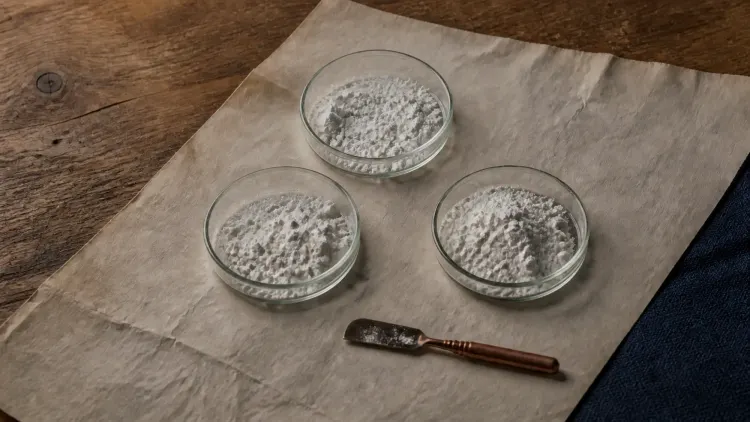
Cover illustration: Separate ingredients do not automatically add up to a better workout. The powder and scoop are illustrative, not a measured dose.
What did the trials actually test?
In a 2016 trial, 54 physically active men used creatine alone, creatine with caffeine, creatine with coffee or placebo for five days. Performance changes did not differ clearly between the treatment groups and placebo on the tested strength and sprint outcomes. Four people in the creatine-plus-caffeine group reported mild gastrointestinal discomfort. The study therefore cannot show that adding coffee improved creatine's effect, but it also did not establish a simple cancellation rule (Trexler et al.).
A different trial found a performance benefit from acute caffeine after a period of creatine loading and caffeine abstinence. That is a different timing pattern from taking both together every day, and the exercise test was different too (Doherty et al.).
Those distinctions matter more than declaring the ingredients compatible or incompatible for everyone. They also explain why an anecdote about one pre-workout drink cannot settle the research question.
Keep the creatine question separate
Our creatine guide covers the evidence for creatine itself, and creatine forms explains why a more expensive form is not automatically better. Neither requires caffeine as a partner. Research on the combination should not be read as evidence that all the established findings for creatine disappear if someone drinks coffee.
Nor do two ingredients with separate evidence necessarily provide an extra combined benefit. Multi-ingredient products can make it harder to identify which substance caused an unwanted effect. NIH ODS notes that many supplement combinations have not been adequately evaluated even when individual ingredients have been studied (NIH ODS).
The practical check is your whole caffeine intake
Count caffeine from coffee, tea, energy drinks and pre-workout products before adding more. A powder is not the only source in the day. Caffeine can cause sleep problems, anxiety and palpitations, with responses varying between people; an athletic study's dose is not a personal recommendation (NIH ODS).
If a combination upsets your stomach or worsens sleep, do not keep increasing it to recreate a study protocol. Review the products with a pharmacist or clinician, especially if you have a heart condition, kidney disease or take medicines. For possible heart-attack symptoms, including new unexplained chest pain, call 911 rather than waiting for an appointment (NHLBI). Other severe symptoms also require urgent assessment, not an experiment with supplement timing.
Keep training and meals consistent enough to judge them. You do not need a forced caffeine-and-creatine stack to follow a sound strength program, and there is no proven universal waiting interval between the two that this evidence can prescribe.
Frequently asked questions
Must I stop drinking coffee if I take creatine?
The evidence does not establish that an ordinary coffee habit cancels creatine. Trial results depend on timing, the exercise tested and the supplementation protocol.
Should I buy a combined pre-workout product?
Combining ingredients on a label does not prove the product works better. Check the amounts, total caffeine from other sources and any medical advice that applies to you.
References
- Heart Attack Symptoms · National Heart, Lung, and Blood Institute
- Effects of Coffee and Caffeine Anhydrous Intake During Creatine Loading · Trexler et al., Journal of Strength and Conditioning Research, 2016
- Caffeine is ergogenic after supplementation of oral creatine monohydrate · Doherty et al., Medicine and Science in Sports and Exercise, 2002
- Creatine and Caffeine, Considerations for Concurrent Supplementation · Trexler and Smith-Ryan, International Journal of Sport Nutrition and Exercise Metabolism, 2015
- Dietary Supplements for Exercise and Athletic Performance · NIH Office of Dietary Supplements
Read next
Creatine forms compared: monohydrate, HCl, buffered and the rest
What each form claims, how much direct evidence it has against monohydrate, what the 2024 and 2025 HCl trials found, and how to compare price per gram.

How much water should you drink on creatine?
There is no creatine-specific water target. What creatine does to your body water, why the scale moves in week one, and what the cramping trials found.

Creatine for men: what it does, how much to take, and the myths
Creatine monohydrate benefits, 3–5 g daily dosing, optional loading, water weight, hair and kidney evidence, caffeine, safety and product testing.