Creatine forms compared: monohydrate, HCl, buffered and the rest
What each form claims, how much direct evidence it has against monohydrate, what the 2024 and 2025 HCl trials found, and how to compare price per gram.

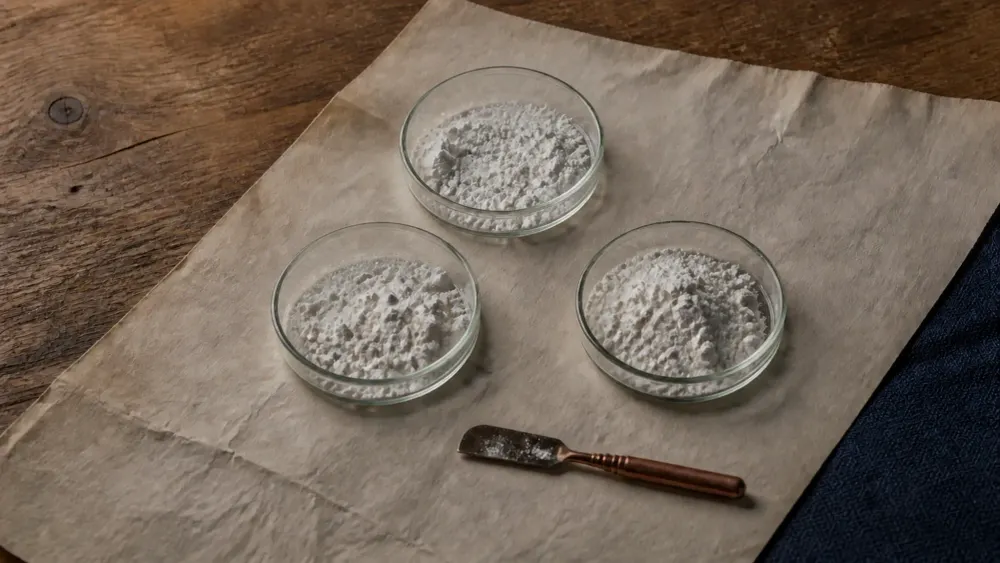
Creatine comes in six forms at five prices, and monohydrate sits at the bottom of both lists. The packaging around it works hard to explain that away: harder on the stomach, poorly absorbed, needs loading, causes bloating.
None of the alternatives has established a consistent advantage over monohydrate. That is not the same as saying they were all tested and beaten. Most of them carry far less evidence, and the useful question when you pick up a tub is how much of it there is.
The reference standard
Monohydrate is creatine bonded to one water molecule, and it is what almost every creatine study used. That is the whole reason it holds its position: the evidence base for creatine is, in practice, the evidence base for monohydrate. The International Society of Sports Nutrition names it the most extensively studied and clinically effective form for raising muscle stores and high-intensity capacity (JISSN, 2017), and a 2022 critical review of the alternatives reached the same conclusion: no purported form has been shown to be a better source of creatine, and several are less bioavailable or barely studied (Nutrients, 2022).
The size of that gap is worth a number. A 2022 systematic review found 17 randomized placebo-controlled trials of alternative forms, and only three compared the alternative directly with monohydrate. Across the rest, no alternative form showed consistent performance benefits even against placebo, and monohydrate was the cheapest form on the market (J Strength Cond Res, 2022).
How much evidence each form has
| Form | The claim | Compared directly with monohydrate? | What that comparison showed |
|---|---|---|---|
| Monohydrate | None needed | It is the comparator | The form nearly all research used |
| Micronized monohydrate | Disperses more easily | Same compound, finer particles | A texture feature, not a different molecule |
| HCl | Dissolves better, tiny dose works | Yes, two small randomized trials, 2024 and 2025 | Similar results to monohydrate, no advantage. The fractional-dose claim was not tested |
| Buffered (Kre-Alkalyn) | Survives the stomach | Yes, one trial | No greater gains in muscle creatine, composition, strength or side effects |
| Ethyl ester | Absorbs better, needs less | Yes, one trial | Lower serum creatine, higher creatinine, no performance advantage |
| Liquid, ready-to-drink | Convenient | Only in specific products | Depends entirely on the product's stability and verified dose |
| Blends with extras | Better than plain creatine | No | Additions may have their own evidence; the creatine is not improved |
HCl: the head-to-head trials now exist
Creatine hydrochloride dissolves in water far more readily than monohydrate. That part is real chemistry, and until recently the honest answer stopped there, because nobody had run the comparison that matters. Two trials have now run it.
In 2024, 40 young adults were randomized to HCl at 0.03 g/kg, monohydrate with a loading phase, monohydrate without loading, or placebo, alongside eight weeks of resistance training at 70% to 85% of one-rep max. All three supplement groups gained strength, muscle cross-sectional area and skeletal muscle mass against placebo. HCl did not separate from either monohydrate protocol (Physiol Res, 2024).
In 2025, a triple-blind trial gave 31 elite handball and softball players 5 g a day of monohydrate, 5 g a day of HCl, or placebo for eight weeks, with DXA body composition and jump testing. The two forms produced similar effects on strength and neuromuscular performance, and only monohydrate showed an increase in fat-free mass index (JISSN, 2025). Two of that paper's authors declare roles with creatine manufacturers, which is worth knowing even though the result favors the cheaper product.
Both trials are small and short, and both used ordinary doses. The marketing line that 750 mg of HCl replaces 5 g of monohydrate still has no trial behind it, because no trial has tested that dose. Better solubility is what you are buying, and better solubility has not turned into better outcomes.
Buffered creatine: no advantage shown
Kre-Alkalyn is monohydrate at a higher pH, sold on the claim that it survives stomach acid better, so a small dose does the work of a large one.
Researchers ran it three ways: the manufacturer's recommended 1.5 g a day, a buffered version with full loading and maintenance, and ordinary monohydrate on the same schedule. Muscle creatine content, body composition, strength and anaerobic capacity showed no statistically meaningful differences, and there was no sign of fewer side effects (JISSN, 2012). The trial was designed to detect an advantage, not to prove equivalence, so the fair reading is that the buffering claim failed rather than that the two are interchangeable.
Ethyl ester: the one that measurably underperformed
The pitch was that an ester group helps creatine cross cell membranes, so you need less. Thirty men trained for seven weeks on placebo, monohydrate or ethyl ester, loading at about 20 g a day for five days then about 5 g a day for six weeks.
Serum creatine was lower in the ester group than in either of the others, and serum creatinine was higher at days 6, 27 and 48. Total muscle creatine rose above placebo in both supplement groups, with no statistical difference between the ester and monohydrate. Strength, power and body composition improved in everyone, with no differences between groups, and the authors concluded the ester was not as effective and put the gains down to the training (JISSN, 2009).
Creatinine is what creatine degrades into. A higher reading is not evidence of kidney harm, but it does complicate a creatinine-based estimate of kidney function, which is a reason to tell your doctor what you take.
Liquids, gummies and other formats
Format is a separate question from chemistry, and it comes down to how much creatine actually survives to reach you.
Creatine in solution converts to creatinine over time, faster in acidic and warm conditions. In one stability study of effervescent creatine formulations, 90% of the creatine had degraded within 45 days at room temperature (AAPS PharmSciTech, 2003). That is the case against a bottle that has been sitting on a shelf. It is not a case against every liquid: a microencapsulated ready-to-drink monohydrate raised plasma creatine 2.3-fold over placebo in a small trial of ten men (J Diet Suppl, 2017). Stability can be engineered, and the manufacturer has to show it.
Gummies and chewables raise the same two questions rather than a verdict: how many grams of creatine are in a full serving, how many pieces that takes, and whether anyone has tested what is actually in them. Mix powder shortly before drinking it rather than leaving it standing, particularly in an acidic drink.
What it costs, and how to compare
Monohydrate was the cheapest form in the 2022 review, and the alternatives generally cost more per gram. Prices vary by country, retailer and pack size, so the comparison to run is not price per serving, which manufacturers define differently, but price per 5 g of actual creatine. HCl servings, gummies and blends all use smaller or padded servings, which is exactly what makes per-serving pricing look competitive.
How much to take, when, and what to expect are in our creatine guide, and the dose calculator works it out for your body weight. If the water question brought you here, creatine and water covers where that water goes.
Reading the tub
Form is close to settled. Manufacturing is the part still worth attention, because creatine is a commodity powder and standards vary.
- Independent certification of that product. NSF Certified for Sport verifies that contents match the label, screens for 290 substances banned in sport and for unsafe contaminant levels, and requires audited GMP facilities (NSF). Check the product and flavor in the certifier's own database rather than trusting a logo on the tub, and note that certification lowers risk without eliminating it.
- A short ingredient list makes the label easier to read, though it is not proof of purity by itself. A proprietary blend hides how much creatine you are buying.
- Price per 5 g of creatine, calculated yourself.
- Anyone drug-tested in sport should treat third-party testing as the minimum rather than a nice extra.
The part the tub cannot sell you
Creatine raises the creatine and phosphocreatine your muscles hold, which lets you repeat hard efforts slightly better and supports the training volume that changes your body over months. That mechanism runs through training. What differs between tubs is how much usable creatine you get for your money, and on that question monohydrate has both the evidence and the lower price.
Frequently asked questions
Which form of creatine is best?
Monohydrate, on the evidence available. It is the form nearly every trial used, the International Society of Sports Nutrition names it the most studied and effective form for raising muscle creatine, and it is usually the cheapest per gram. No competing form has shown a repeated, meaningful advantage over an equivalent dose of monohydrate.
Is creatine HCl better absorbed?
It dissolves more readily in water, which is a real chemical difference rather than a performance claim. Two randomized trials have now compared it directly with monohydrate, in 2024 and 2025, and both found similar results between the two forms with no advantage for HCl. Both used ordinary doses, around 5 g a day, so the marketing claim that a fraction of a gram does the same job remains untested.
What about buffered creatine, like Kre-Alkalyn?
Tested against monohydrate and it showed no advantage. Neither the manufacturer's recommended 1.5 g a day nor a buffered version with full loading produced greater gains in muscle creatine, body composition, strength or anaerobic capacity, and there was no evidence of fewer side effects. The trial was not designed to prove the two are equivalent, only that the buffered form was not better.
Is creatine ethyl ester worth trying?
No. In a 47-day trial with resistance training, the ester group ended with lower serum creatine and higher serum creatinine than monohydrate. Total muscle creatine rose above placebo in both supplement groups with no difference between them, and the authors concluded the ester was not as effective and attributed the training gains to the training.
Does the powder need to be micronized?
No. Micronized monohydrate is the same molecule ground to a smaller particle size, which is intended to disperse more easily in liquid. It is a texture and convenience feature, not a different compound, and it is worth only a small premium.
References
- International Society of Sports Nutrition position stand: safety and efficacy of creatine supplementation in exercise, sport, and medicine · Journal of the International Society of Sports Nutrition, 2017
- Bioavailability, Efficacy, Safety, and Regulatory Status of Creatine and Related Compounds: A Critical Review · Nutrients, 2022
- Efficacy of Alternative Forms of Creatine Supplementation on Improving Performance and Body Composition in Healthy Subjects: A Systematic Review · Journal of Strength and Conditioning Research, 2022
- Supplementing With Which Form of Creatine (Hydrochloride or Monohydrate) Alongside Resistance Training Can Have More Impacts on Anabolic/Catabolic Hormones, Strength and Body Composition? · Physiological Research, 2024
- Creatine monohydrate versus creatine hydrochloride on strength and body composition in elite team-sport athletes: a placebo-controlled randomized clinical trial comparing low dosages · Journal of the International Society of Sports Nutrition, 2025
- The effects of creatine ethyl ester supplementation combined with heavy resistance training on body composition, muscle performance, and serum and muscle creatine levels · Journal of the International Society of Sports Nutrition, 2009
- A buffered form of creatine does not promote greater changes in muscle creatine content, body composition, or training adaptations than creatine monohydrate · Journal of the International Society of Sports Nutrition, 2012
- Evaluation of the stability of creatine in solution prepared from effervescent creatine formulations · AAPS PharmSciTech, 2003
- Plasma Creatine Kinetics After Ingestion of Microencapsulated Creatine Monohydrate with Enhanced Stability in Aqueous Solutions · Journal of Dietary Supplements, 2017
- NSF Certified for Sport · NSF
Read next

How much water should you drink on creatine?
There is no creatine-specific water target. What creatine does to your body water, why the scale moves in week one, and what the cramping trials found.
Creatine for men: what it does, how much to take, and the myths
Creatine monohydrate benefits, 3–5 g daily dosing, optional loading, water weight, hair and kidney evidence, caffeine, safety and product testing.
Do testosterone boosters work? What trials show
Most testosterone boosters do not reliably work. Here is what human trials show for common ingredients, the safety limits, and when to get tested.