Reading your lipid panel: what the cholesterol numbers mean
LDL, HDL, triglycerides and non-HDL in both units. Which number carries the risk, whether you need to fast, and what your result decides.


A lipid panel comes back as four or five numbers and a comment. Most men read the top line, see "total cholesterol", and stop reading. That is unfortunate, because the top line is the least informative one on the page.
Here is what each number means, which ones carry the most risk information, and why the result is an input into a cardiovascular risk assessment, not a verdict.
What the panel measures
- LDL cholesterol. The fraction that deposits in artery walls, and the main character in the cholesterol-and-heart-disease story.
- HDL cholesterol. Carries cholesterol back to the liver. A low HDL level can travel with higher cardiovascular risk, but very high HDL is not automatically protective and raising HDL itself with medication has not reliably reduced cardiovascular events. It is not a treatment target to maximize.
- Triglycerides. A separate fat, sensitive to alcohol, refined carbohydrate and excess weight.
- Total cholesterol. LDL plus HDL plus a share of the rest. Because it mixes harmful and protective fractions, two men with the same total can carry very different risk.
- Non-HDL cholesterol. Total minus HDL. Everything left is cholesterol in particles that can contribute to plaque. UK practice uses it as a headline number, and a recent meal doesn't spoil it.
A standard lipid profile directly measures total cholesterol, HDL-C and triglycerides. LDL-C is usually estimated from those values rather than measured directly. The 2026 ACC/AHA guideline prefers the Martin/Hopkins or Sampson/NIH equations over the older Friedewald equation because they are more accurate across a wider range of LDL and triglyceride values. If your report says “calculated LDL,” the laboratory method matters most when triglycerides are raised or LDL is already low.
General reference levels, in both units
| Measure | US adult reference (mg/dL) | NHS (mmol/L) |
|---|---|---|
| Total cholesterol | Below 200 | Below 5 |
| LDL cholesterol | Below 100 as a general adult reference; treatment goals can be lower or differ by risk group | Not given separately |
| Non-HDL cholesterol | Below 130 (MedlinePlus adult guide) | Below 4 |
| HDL cholesterol | Below 40 is low; 60 or above is often labelled optimal | Above 1.0 for men |
| Triglycerides | Below 150 | Not given separately |
Sources: Cleveland Clinic for US total, LDL, HDL and triglyceride reference figures; MedlinePlus for the HDL below-40 and non-HDL below-130 interpretations; and the NHS for UK values. Notice the two systems report in different units and pick different headline numbers, so keep that in mind before comparing your result with something you read online. To convert, divide mg/dL by roughly 38.7 to get mmol/L for cholesterol.
These are general reference figures, not personal treatment targets. If you have cardiovascular disease, diabetes or another major risk factor, the number your clinician aims for depends on your clinical context and the guideline being used.
Do you need to fast?
For routine baseline testing, the 2026 ACC/AHA guideline accepts either a fasting or non-fasting lipid panel. A fasting repeat is useful when a non-fasting sample shows triglycerides at or above 400 mg/dL (4.5 mmol/L), or when a triglyceride disorder, familial dyslipidaemia or premature cardiovascular disease is known or suspected. Follow the instructions from the clinician or laboratory ordering your test.
A recent meal affects triglycerides more than the other headline values and can also affect a calculated LDL result. Do not keep postponing routine screening solely because fasting is inconvenient: for most people a non-fasting baseline is valid, and the clinician can request a fasting repeat when the result or history calls for one.
Which numbers deserve the most attention
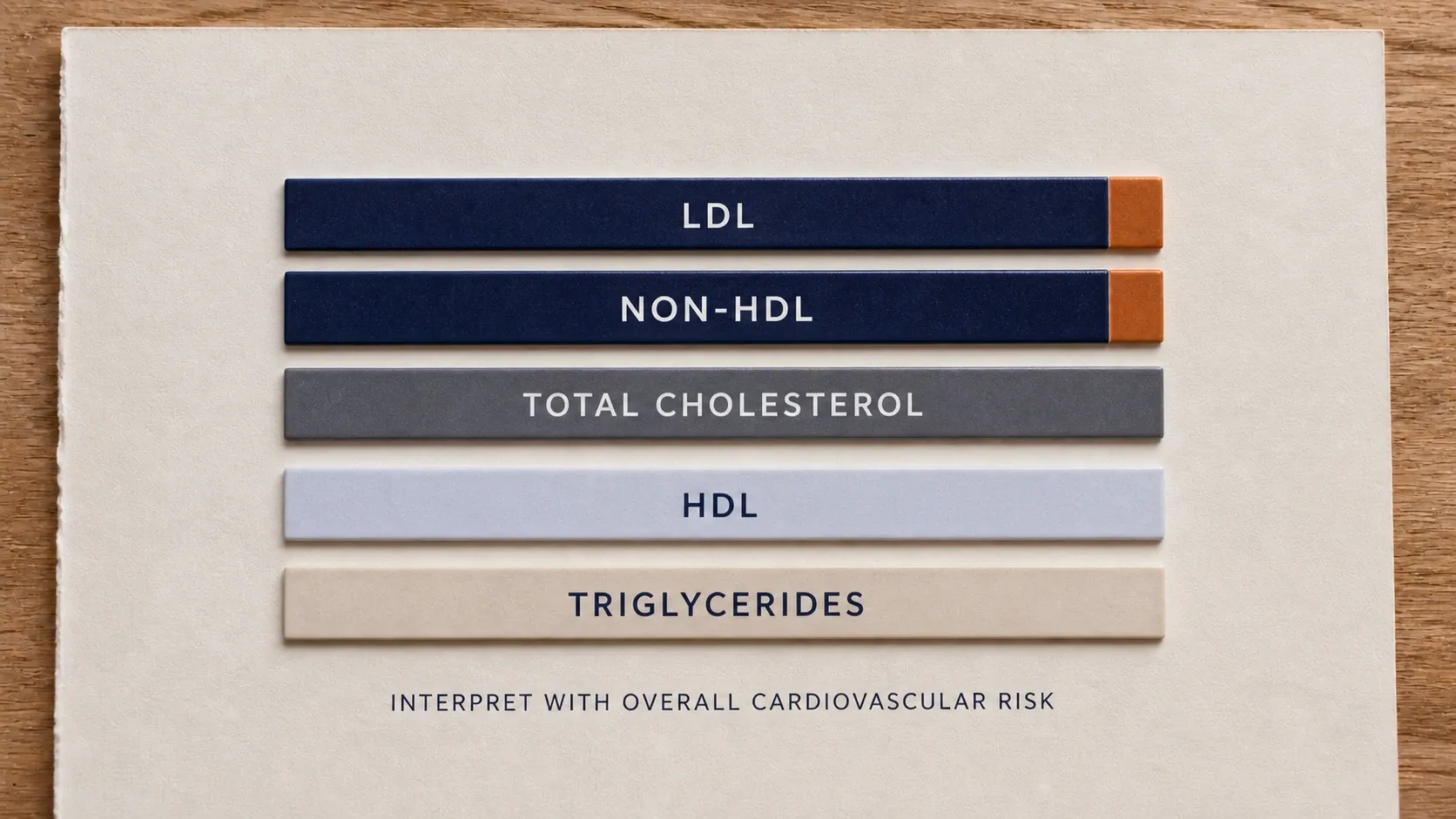
Start with non-HDL and LDL. They reflect cholesterol carried in atherogenic particles that can enter artery walls. Both need to be interpreted alongside your overall risk and history; a routine reference level is not a universal treatment decision.
ApoB reflects the number of atherogenic particles rather than the cholesterol inside them, but it is not a universal part of a lipid panel. The 2026 ACC/AHA guideline says it is reasonable to measure ApoB selectively in adults already taking lipid-lowering treatment, particularly after LDL-C and non-HDL-C goals are reached when high triglycerides, diabetes, cardiovascular-kidney-metabolic syndrome or established cardiovascular disease may leave residual risk. A weaker recommendation allows selective use without treatment when it may clarify risk or an inherited disorder.
Two misreadings to avoid:
- A high HDL does not cancel a high LDL. It is not a ledger where the good balances the bad.
- A normal total does not launder the rest of an abnormal panel. If LDL or triglycerides are off, "but my total is fine" is no answer.
The number the panel leaves out
A standard lipid panel measures how much cholesterol you are carrying. It does not measure one thing that is largely fixed at birth and usually changes little with diet or other lifestyle measures.
Lipoprotein(a), written Lp(a), is an inherited particle that carries cholesterol and behaves like LDL, except that lifestyle barely moves it. Someone with an unremarkable panel can still be carrying a raised Lp(a) and not know. The European Atherosclerosis Society panel recommends testing it at least once in adult life (Eur Heart J, 2022).
Three things follow from that:
- One test is usually enough. The level is inherited and stays broadly stable, so unlike cholesterol there is nothing to re-check every few years, unless a doctor has a specific reason to repeat it.
- You have to ask for it by name. It is not part of routine testing in most places, and it will not appear on a standard panel by accident.
- The case is strongest if heart disease runs in your family early and nobody has ever explained why. That is the situation an ordinary panel is most likely to leave unanswered.
What moves the numbers
The NHS lists the drivers plainly: fatty food, too little exercise, excess weight, smoking and alcohol, alongside things you cannot change such as age and family history (NHS).
Triglycerides respond to alcohol, diet and weight. LDL responds to lifestyle too, particularly the balance of saturated and unsaturated fats, but genetics can hold it up regardless of how carefully you eat. If your LDL stays high despite sensible changes, that's a prompt to discuss overall risk and treatment options with your doctor, not evidence of personal failure.
And since central fat is a marker of metabolic risk in its own right, the tape measure belongs next to the blood test. Across 72 pooled cohort studies, each extra 10 cm on the tape tracked an 11% rise in death from any cause, an association that survived adjustment for BMI (BMJ, 2020). Our guide to belly fat covers what actually shifts it.
Your result is one input, not the answer
For most primary-prevention decisions, lipid values are read with age, blood pressure, smoking status, diabetes, kidney health, family history and a calculated risk estimate. Important exceptions include severe hypercholesterolaemia, familial hypercholesterolaemia, established cardiovascular disease and some high-risk conditions, which follow dedicated pathways rather than waiting for a short-term score to cross a line.
Ask what your values mean in your risk category, which guideline is being used and what target, if any, applies to you. Two men with identical LDL can receive different advice for valid reasons.
What happens if the result is high
Treatment is not triggered by one universal number. In UK primary prevention, NICE usually offers atorvastatin 20 mg when 10-year QRISK3 reaches 10%, while allowing treatment below that threshold after discussion or when risk may be underestimated. The 2026 US guideline uses PREVENT-ASCVD categories and restored risk-specific LDL-C and non-HDL-C goals: below 100 mg/dL for many treated borderline- or intermediate-risk adults and below 70 mg/dL for high-risk adults. Severe LDL elevation and several high-risk conditions have separate recommendations.
Very high triglycerides need a different response. A fasting result of 500 mg/dL (5.7 mmol/L) or higher deserves prompt clinical follow-up because treatment may need to focus on lowering pancreatitis risk as well as cardiovascular risk. At 1,000 mg/dL (11.3 mmol/L) or higher, the 2026 ACC/AHA guideline recommends intensive dietary and clinical management. NICE uses different urgent-review thresholds: seek urgent specialist review above 20 mmol/L when alcohol or poor glucose control does not explain the result, and repeat a fasting test after at least 5 days but within 2 weeks for results between 10 and 20 mmol/L, check for secondary causes and seek specialist advice if the repeat remains above 10 mmol/L. Do not try to manage a result in this range from an online article.
Two things follow, and they point in opposite directions:
- A high LDL with a low overall risk does not automatically mean there is nothing to do. If LDL is moderately raised and overall cardiovascular risk is low, a clinician may reasonably start with lifestyle changes and follow-up rather than medication. That does not apply automatically to very high LDL, particularly LDL-C at or above 190 mg/dL (4.9 mmol/L), or to familial hypercholesterolaemia, diabetes, chronic kidney disease or other high-risk conditions, which need separate assessment and may warrant treatment despite a low short-term risk score.
- An unremarkable panel with smoking, a large waist and a family history can still clear the treatment threshold.
The panel is one input into a decision that also depends on your history and risk; very high LDL and certain conditions need their own assessment even when a short-term score looks low.
When to test, and when to act sooner
Do not wait until your 40s for a first test. The 2026 ACC/AHA guideline recommends beginning lipid-profile screening at age 19 and repeating it at least every five years, with more frequent testing when risk factors or abnormal results call for it. The American Heart Association gives the same practical message for adult screening. US PREVENT-ASCVD estimates can guide appropriate adults aged 30 to 79, while NICE QRISK3 covers eligible adults aged 25 to 84; the calculator and exceptions depend on the healthcare system.
Bring the appointment forward if:
- New erectile dysfunction has started. Treat it as a prompt for a full cardiovascular risk assessment rather than a cholesterol check on its own. QRISK3, the risk calculator NICE recommends, counts erectile dysfunction among its inputs precisely because older tools underestimated risk in these men (NICE). An umbrella review found men with erectile dysfunction carried a 45% higher risk of cardiovascular disease (BJU Int, 2021). Our guide to erectile dysfunction explains the link.
- Heart or vascular disease occurred unusually early in a parent or sibling. The 2026 US guideline uses onset before 55 in a male first-degree relative or before 65 in a female first-degree relative as a risk enhancer. NICE CG71 defines premature coronary disease here as a coronary event before 60 in a first-degree relative, so the relevant threshold depends on the guideline and type of event.
- You have chest tightness, breathlessness on exertion, or calf pain when walking that eases with rest. Those need assessment now, not a blood test in a few weeks.
A lipid panel is cheap, quick and one of the few tests that can change the course of the next twenty years. The trick is reading the right line on it.
Frequently asked questions
When are high triglycerides urgent?
A fasting triglyceride result of 500 mg/dL (5.7 mmol/L) or higher needs prompt clinical follow-up because pancreatitis prevention may become part of treatment. At 1,000 mg/dL (11.3 mmol/L) or higher, the 2026 ACC/AHA guideline recommends intensive management. NICE uses different specialist-review thresholds, including urgent review above 20 mmol/L when alcohol or poor glucose control does not explain the result. Do not self-treat a result in this range.
What are healthy cholesterol numbers for a man?
General US reference figures for adult men include total cholesterol below 200 mg/dL, LDL below 100, non-HDL below 130 and triglycerides below 150. For HDL, below 40 is considered low in men and 60 or higher is often labelled optimal, but HDL is not a treatment target and very high values are not automatically protective. These are screening references, not universal treatment goals; higher-risk groups can have lower LDL targets, while UK reports use mmol/L and different pathways.
Do I have to fast before a cholesterol test?
Usually not for a routine baseline test. The 2026 ACC/AHA guideline accepts fasting or non-fasting panels. A fasting repeat is useful when a non-fasting result shows triglycerides at or above 400 mg/dL (4.5 mmol/L), or when a triglyceride disorder, familial dyslipidaemia or premature cardiovascular disease is known or suspected. Follow the ordering clinician or laboratory's instructions.
Which cholesterol number matters most?
LDL and non-HDL are the main numbers for routine cardiovascular-risk interpretation. ApoB is a selective add-on, not a universal panel item; the 2026 ACC/AHA guideline particularly supports it for some adults already on lipid-lowering treatment after LDL-C and non-HDL-C goals are reached. Lp(a) is a separate inherited marker worth measuring at least once in adulthood.
Can I fix high cholesterol without medication?
Diet, activity, weight, smoking and alcohol can improve the lipid profile and cardiovascular risk. Whether lifestyle alone is enough depends on LDL elevation and overall risk. Severe hypercholesterolaemia, familial hypercholesterolaemia, established cardiovascular disease and some high-risk conditions often warrant medication as well.
Should I have my Lp(a) tested?
Yes, once in adulthood is recommended by the 2026 ACC/AHA guideline. Lp(a) is mostly inherited, minimally affected by lifestyle and absent from a standard lipid panel. Repeat testing is generally unnecessary without a specific reason, but a high result can change risk discussions and prompt testing of close relatives.
At what cholesterol level do you need a statin?
There is no single threshold for every adult. LDL-C at or above 190 mg/dL (4.9 mmol/L), familial hypercholesterolaemia, established cardiovascular disease and some high-risk conditions follow dedicated pathways. Otherwise, decisions combine lipid values with risk and clinical context. NICE usually offers atorvastatin 20 mg at a 10-year QRISK3 score of 10%; the 2026 US guideline uses PREVENT-ASCVD categories and risk-specific LDL goals.