The testosterone blood test explained: total, free and what your number means
How total and free testosterone tests work, why timing matters, what a result below 300 ng/dL can mean, and which laboratory tests may come next.



A testosterone test looks like a simple thing to order. One vial, one number, one answer.
It rarely works out that way. The time of day the blood was drawn, the form of testosterone that was measured and the laboratory that ran it all affect what comes back. Testing is easy. Interpreting the result is the difficult part.
Here is what the test measures, the conditions that make a result usable, and how the number fits into a diagnosis.
When a testosterone test is worth ordering
Cleveland Clinic lists the symptoms that usually prompt the test in men past puberty: erectile dysfunction, infertility, low libido, loss of armpit and pubic hair, low muscle mass and gynecomastia (Cleveland Clinic).
Tiredness, low mood and a thickening waist are the complaints men more often arrive with, and they are absent from that list, because on their own they point in too many directions. Our guide to the signs of low testosterone separates the symptoms that track hormones from the ones that mislead, and erectile difficulty has a guide of its own, since it carries cardiovascular meaning as well.
Symptoms are not a perfect filter in either direction. Not every man with a low level has symptoms, and the only way to know your level is to measure it (Cleveland Clinic).

What the test measures
Most of the testosterone circulating in your blood is bound to protein. Some is held tightly by sex hormone binding globulin (SHBG). Some is bound loosely to albumin and comes free more easily. A small share circulates unbound.
That gives three ways to report it:
- Total testosterone. Everything, bound and unbound. This is the standard first test.
- Free testosterone. The unbound portion only, which can be more helpful for diagnosing certain conditions (Cleveland Clinic).
- Bioavailable testosterone. Generally the free fraction plus the albumin-bound fraction.
Total testosterone is the right starting point for almost everyone.
When free testosterone helps
SHBG is the reason the free test exists. Obesity tends to lower it, while aging, liver disease and thyroid problems tend to raise it. When SHBG is shifted, total testosterone may not track free testosterone in the usual way, so the total result can be harder to interpret on its own.
The Endocrine Society suggests obtaining a free testosterone concentration in men whose total is near the lower limit of normal, or who have a condition that alters SHBG (JCEM, 2018).
| Your situation | Is total testosterone enough? |
|---|---|
| Comfortably normal total, no SHBG-shifting condition | Usually yes |
| Total near the lower limit of the laboratory range | Free testosterone and SHBG may add information |
| Obesity or type 2 diabetes, which tend to lower SHBG | Free testosterone and SHBG may add information |
| Aging, liver disease or thyroid disease, which tend to raise SHBG | Free testosterone and SHBG may add information |
The method matters as much as the order. The Endocrine Society specifies equilibrium dialysis, or an estimate calculated from total testosterone, SHBG and albumin using an accurate formula. Direct analog immunoassays are considered less reliable. If a free testosterone result is going to influence a decision, ask which method produced it.
How to get a usable result
Two conditions decide whether a reading can carry any weight.
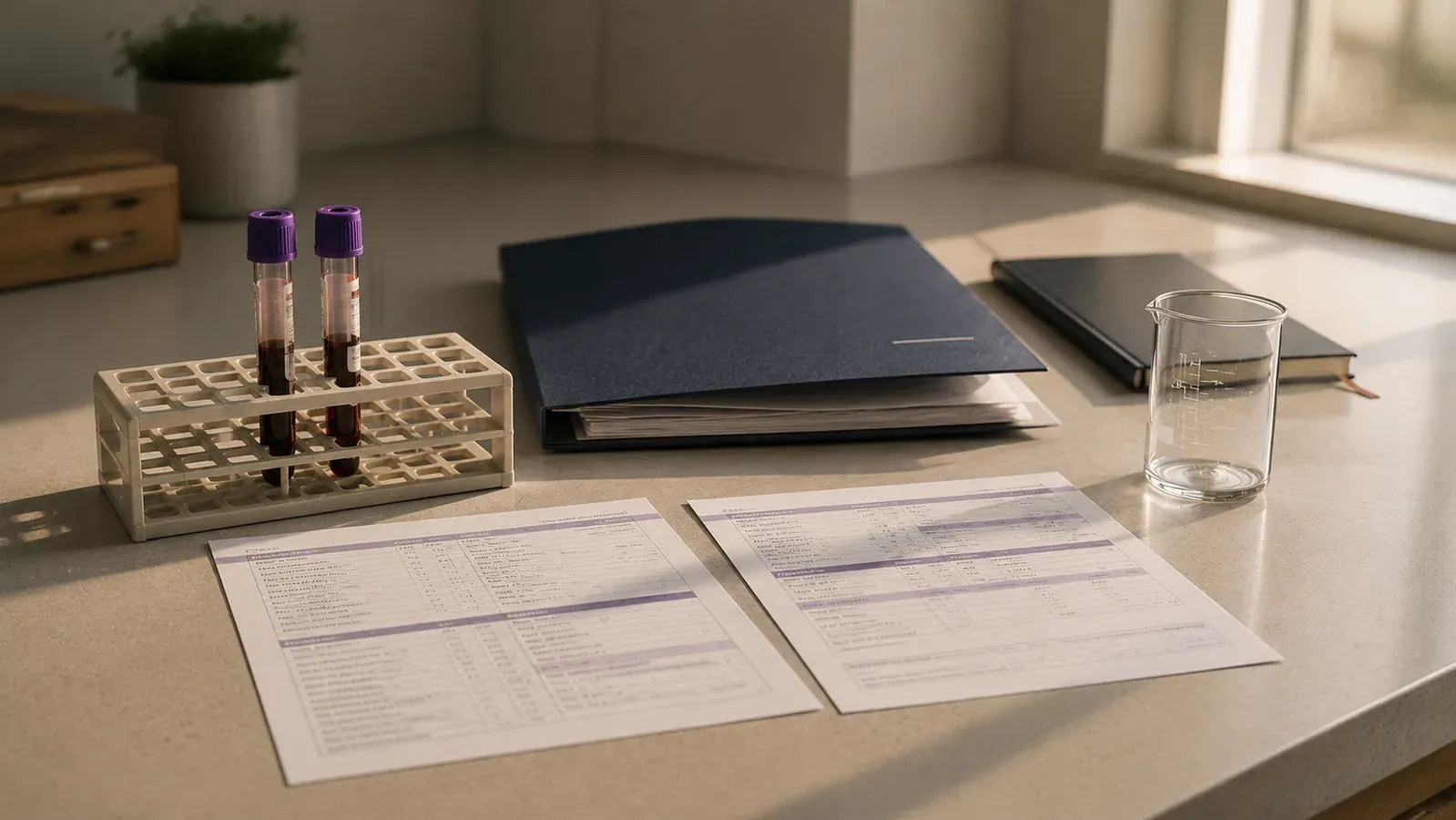
A correctly timed first sample. The Endocrine Society and the 2026 EAU guideline specify a morning, fasting total-testosterone measurement with a reliable assay. The AUA requires early-morning testing but does not add a fasting requirement to that diagnostic statement. Follow the instructions from your clinician and laboratory; if fasting is requested, water is usually allowed unless another test changes the instructions.
For most men, the EAU window is 7 to 10 a.m. Night-shift workers are different because testosterone timing follows sleep more than clock time. The EAU advises a fasting sample after an adequate main sleep period, and joint UK laboratory guidance says biochemical confirmation in shift workers is complex enough to warrant specialist input.
A second measurement. The AUA recommends making the diagnosis only after two total-testosterone measurements on separate occasions, both obtained early in the morning. When possible, use the same laboratory and assay because methods and reference ranges differ. Do not test while acutely ill.
Why the test needs repeating
Testosterone varies from day to day. A 2007 study measured several reproductive and adrenal hormones repeatedly and found substantial within-person variation, but its quoted 18% to 28% range applied across different hormones rather than to testosterone alone. The practical conclusion is still sound: one sample is usually not enough to characterize a man’s hormone status.
The question a doctor is trying to answer is not whether your testosterone was low once, but whether it is low consistently, alongside symptoms or signs that fit.
| What can move the number | How to read it | What it calls for |
|---|---|---|
| A sample taken later in the day | Can temporarily influence the result | Repeat at the time your laboratory advises |
| Acute illness | Can temporarily influence the result | Test once you are well again |
| Severe sleep loss or acute physiological stress | Can temporarily influence the result | Note it, and discuss timing before retesting |
| Ordinary day-to-day variation | Expected, and often large | A second early morning sample |
| Medications and other health conditions | Can affect the result in either direction | Bring the full list to the appointment |
| A problem in the testicles, or in the pituitary and hypothalamus | A possible underlying cause rather than a temporary influence | Further tests to work out which |
An abnormal result does not by itself mean you have a medical condition. Medications, other conditions and errors in processing all feed into it, and your history is part of the interpretation (Cleveland Clinic).

How to prepare, and do you need to fast?
- Book an early morning appointment, and follow the laboratory's own timing and fasting instructions.
- Avoid testing during an acute illness. If you have recently been unwell, wait until sleep, appetite and routine are back to normal, or ask when to retest.
- Take a full list of your medicines and supplements, prescription and otherwise. Do not stop anything on your own account.
- If a repeat is likely, book it at the same laboratory.
- Ask for the printed report, including the reference range and, if free testosterone was ordered, the method used.
What do my testosterone results mean?
The AUA uses a total testosterone below 300 ng/dL as a reasonable cut-off supporting a diagnosis of testosterone deficiency, and is explicit that the clinical diagnosis is made only when a low level occurs together with symptoms or signs. Reference ranges and methods vary between laboratories, so your own report's range is the one that applies to your result (Cleveland Clinic).
The AUA guideline was published in 2018 and reviewed with validity confirmed in 2024. The Endocrine Society’s July 2026 statement also describes a common clinical threshold near 300 ng/dL, while stressing standardized assays and diagnosis based on symptoms plus at least two low early-morning fasting results. The EAU uses a different threshold for late-onset hypogonadism, another reason 300 ng/dL is not a universal boundary.
| Your result | What it usually means | Sensible next step |
|---|---|---|
| Below 300 ng/dL, with symptoms | Consistent with possible testosterone deficiency, not yet confirmed | Repeat on a second morning, then discuss causes with a doctor |
| Below 300 ng/dL, no symptoms | A number, not a diagnosis | Repeat, and look for an explanation such as illness, sleep or weight |
| Near the lower end of your laboratory's range, with symptoms that fit | Unsettled. Assay, reference range and SHBG all affect how it reads | Repeat, and ask whether free testosterone and SHBG would add anything |
| Comfortably normal, with symptoms | Testosterone deficiency is less likely, but SHBG can matter when a condition changes binding | Review other causes; if symptoms strongly conflict with the result or SHBG may be altered, ask whether SHBG and reliable free testosterone testing are indicated |
Interpretation depends on more than the figure itself: the symptoms it sits beside, the repeat result, the assay, the laboratory's range and, in the right context, SHBG and free testosterone. Chasing a higher number inside the normal range is not a medical goal.
ng/dL, nmol/L and reference ranges
Reports outside the United States usually print nmol/L rather than ng/dL. The conversion is arithmetic: divide ng/dL by about 28.8, which puts the 300 ng/dL decision point at roughly 10.4 nmol/L.
Ranges themselves vary between laboratories and assays, and with age (Cleveland Clinic). The same figure can sit inside one laboratory's range and below another's, which is why the range printed next to your result is the one worth reading. Typical levels by age show how far the middle of that range moves between your twenties and your forties.

What doctors may test next
A confirmed low result raises the question of cause. The AUA recommends measuring luteinizing hormone (LH) in men with low testosterone, and prolactin when LH is low or low-normal. LH helps separate a problem in the testicles from a problem with the signal from the brain, and that distinction changes what happens next.
These cause-finding tests are separate from pretreatment safety checks. Before testosterone therapy, the AUA calls for hemoglobin and hematocrit, plus PSA in men over 40. Fertility plans must be discussed before treatment because exogenous testosterone can suppress sperm production. If treatment starts, AUA follow-up guidance measures testosterone and hematocrit during titration and every 6 to 12 months once stable; PSA follow-up depends on age, risk and shared decision-making. Our TRT guide covers the treatment decision and monitoring in detail.
The Endocrine Society also lists situations that require avoiding or delaying therapy or further evaluation, including near-term fertility plans, prostate or breast cancer, an unevaluated raised PSA, raised hematocrit, untreated severe sleep apnea, severe urinary symptoms, uncontrolled heart failure, myocardial infarction or stroke within six months, and thrombophilia. This is a clinician assessment, not a checklist for self-treatment.
Depending on symptoms, a workup often adds thyroid function, HbA1c or fasting glucose, ferritin and a lipid panel. Fatigue and low drive have several possible causes, as our guide to persistent tiredness sets out, and testing testosterone alone is how the others get missed.
Questions to ask your doctor
- Was this a fasting early morning sample, and when should it be repeated?
- What is this laboratory's reference range, and which assay produced my number?
- If free testosterone was measured, was it equilibrium dialysis or a calculated estimate?
- Have we looked for a cause, rather than stopping at the level itself?
- Could any of my medicines or other conditions be affecting this result?
Testosterone test checklist
- Book an early morning, fasting draw, following your laboratory's instructions.
- Postpone the test if you are acutely unwell.
- Repeat a low result at the same laboratory before drawing conclusions.
- Read the number against your own report's range and your symptoms.
- Take the printout to a doctor if the level is genuinely low, since some causes are reversible.
At-home kits sit in a middle position. Their quality depends on the sample type, the timing of collection, the assay and the laboratory behind them, and Cleveland Clinic notes that accuracy varies and advises against self-diagnosis (Cleveland Clinic). A result from one can be a reasonable prompt to get tested properly. It is not a diagnosis, and a low reading still needs confirmation with a properly timed laboratory measurement and a clinical review.
That is also the argument against buying a supplement on the strength of one reading. Evidence for marketed testosterone boosters is weak and ingredient-specific, and an unconfirmed number is a poor reason to start one.
Frequently asked questions
What is a normal testosterone level for a man?
There is no single universal number. Laboratories use different assays and print different reference ranges, so your result should be read against the range on your own report. As a decision point, the American Urological Association treats a total testosterone below 300 ng/dL as a reasonable cut-off supporting a diagnosis, and a clinical diagnosis also requires repeat early morning measurements together with symptoms or signs.
Why does the timing of a testosterone test matter?
Testosterone follows a daily rhythm. For most men, the Endocrine Society and EAU specify a fasting early-morning sample, while the AUA diagnostic statement requires early morning without adding fasting. An unexpectedly low result is repeated under appropriate conditions. If you work nights, ask for timing after an adequate main sleep period rather than assuming 7 to 10 a.m. applies after an overnight shift.
Do I need to test free testosterone as well?
Not routinely. The Endocrine Society suggests measuring free testosterone when the total sits near the lower limit of normal, or when a condition is likely to alter SHBG, such as obesity, thyroid disease, liver disease or older age. How it is measured matters, so ask whether the result came from equilibrium dialysis or an accurate calculation.
Can one low testosterone result be wrong?
Yes. Testosterone varies from day to day, and food, timing, acute illness, sleep and assay differences can affect a result. Diagnosis therefore requires a second properly timed total-testosterone measurement on a separate day, interpreted with symptoms or signs rather than on its own.
What else should be tested alongside testosterone?
A confirmed low result raises the question of cause, so the AUA recommends measuring luteinizing hormone, and prolactin when LH is low or low-normal. Before therapy it also calls for hemoglobin, hematocrit and a PSA in men over 40. Depending on symptoms, a workup often adds thyroid function, HbA1c or fasting glucose, ferritin and a lipid panel.
My testosterone came back normal but the symptoms are still there. What now?
Chasing a higher number inside the normal range is not a medical goal. Interpretation depends on the symptoms the figure sits beside, the repeat result, the assay and your own laboratory's range, so the next step is looking for other causes of the symptoms rather than retesting until a low number appears.
Read next

A low testosterone result: why the next step is often a repeat test
Understand why one low reading is not enough, how morning sampling helps, and what to ask before starting treatment or buying a booster.

Taking creatine before a kidney blood test: what to tell your clinician
Creatine can complicate interpretation of creatinine. Learn what to disclose and why an abnormal kidney result should never be dismissed on your own.

Reading your lipid panel: what the cholesterol numbers mean
LDL, HDL, triglycerides and non-HDL in both units. Which number carries the risk, whether you need to fast, and what your result decides.