Erectile dysfunction: causes, and when it is a warning about your heart
Why ED can be an early sign of a circulation problem, how physical and psychological causes overlap, what a doctor may check, and which treatments help.

Erectile dysfunction (ED) means a consistent or recurrent difficulty getting or keeping an erection sufficient for satisfactory sexual activity. An occasional problem after stress, tiredness or alcohol is not the same as persistent ED. If it keeps happening, arrange a medical assessment: ED is treatable, its causes are often mixed, and it can be a marker of cardiovascular risk.
Cleveland Clinic describes it as the most common sex-related condition men report, affecting more than half of men between 40 and 70 (Cleveland Clinic). The useful question is not whether it happens to men like you. What matters is the cause in your case.
Why cardiovascular risk belongs in the assessment
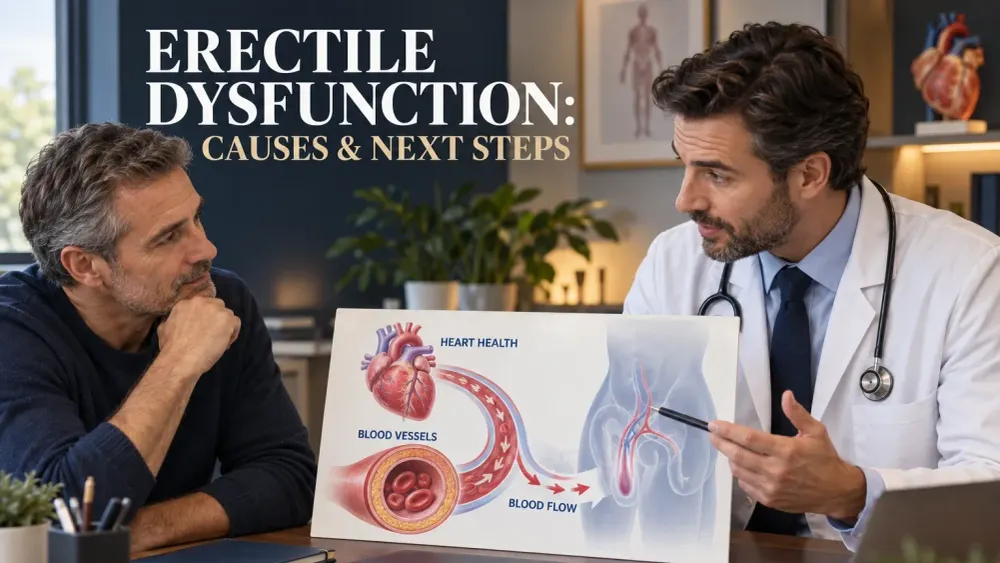
Blood-vessel disease is a common contributor to ED, but it is not the only one. Diabetes, nerve injury, pelvic surgery or radiation, hormonal disorders, medicines, depression, anxiety and relationship stress can overlap. The current EAU guideline cautions that most cases have mixed causes. The AUA guideline treats ED as a cardiovascular risk marker that may warrant evaluation, not as proof that a man has heart disease.
The numbers back the warning. An umbrella review pooling systematic reviews and meta-analyses found that men with ED carry higher risks across the board (BJU Int, 2021):
| Outcome | Risk compared with men without ED |
|---|---|
| Cardiovascular disease | 45% higher |
| Coronary heart disease | 50% higher |
| Heart attack | 55% higher |
| Stroke | 36% higher |
| Death from any cause | 25% higher |
These are pooled relative associations, not an estimate of your absolute chance of a heart attack or stroke. For example, 55% higher relative risk does not mean a 55-percentage-point increase. The review does not provide one absolute risk that applies to every reader. Age, blood pressure, cholesterol, diabetes, smoking and existing cardiovascular disease materially change baseline risk. ED can precede symptomatic cardiovascular disease in some men. Princeton IV guidance summarized by the ACC recommends cardiovascular risk assessment for men with likely vasculogenic ED rather than translating this table into an individual diagnosis.
Common causes
Rarely one thing. The usual contributors:
- Vascular. Atherosclerosis, high blood pressure, high cholesterol, diabetes, smoking. The largest group.
- Metabolic. Type 2 diabetes and obesity, which damage both vessels and nerves.
- Neurological. Nerve damage from diabetes, spinal injury, surgery or pelvic radiation.
- Hormonal. Low testosterone or thyroid problems.
- Psychological. Depression, anxiety, stress, relationship strain, performance worry.
- Medications. Antidepressants, blood pressure drugs, antihistamines, muscle relaxants and sedatives are common culprits.
- Alcohol and tiredness. The NHS notes that occasional problems are usually explained by stress, tiredness or drinking too much (NHS).
Clues about contributors, not a home diagnosis
Preserved morning, nocturnal or masturbatory erections suggest, but do not confirm, a psychological component. Their absence does not prove a vascular or hormonal cause. Sleep quality, age, depression, medicines and other health conditions affect these erections. Current AUA and EAU guidance uses these details as part of a full medical, sexual and psychosocial history because mixed causes are common.
| What you notice | More likely physical | More likely psychological |
|---|---|---|
| Morning and overnight erections | Absent or much weaker | Still happening |
| How it started | Gradual, over months or years | Suddenly, around a specific event |
| Consistency | Every time, every partner, alone too | Situational, varies by partner or setting |
| Company it keeps | High blood pressure, diabetes, high cholesterol, smoking | Low mood, anxiety, stress, relationship strain |
The honest caveat is that these signals are no longer treated as proof of anything, and most cases have both a physical and a psychological element. Anxiety about performance builds fast on top of a physical problem, and then outlives it.

What your doctor should check
Book with a doctor or a urologist rather than a website. A reasonable first appointment looks at your medications, blood pressure, weight, smoking and alcohol, and asks about mood and your relationship. The NHS lists blood pressure and a basic examination as standard, alongside questions about lifestyle.
A clinician may check fasting glucose or HbA1c and a lipid profile if they have not been assessed recently. Current AUA guidance recommends a morning total-testosterone measurement in men with ED; current EAU guidance specifies a fasting early-morning sample. Low libido makes testosterone deficiency more plausible, but it is not a prerequisite for the test. Low or borderline results need proper repeat testing and interpretation rather than self-treatment. That process is explained in the testosterone blood test guide and signs of low testosterone.

What helps
Exercise. Aerobic exercise can improve erectile function, especially when vascular risk factors are present. A 2018 review proposed 40 minutes of moderate-to-vigorous aerobic exercise four times weekly for six months for selected men with arterial ED. A newer meta-analysis of 11 randomized trials also found benefit, but programs varied, so this is an evidence-based example rather than one universal prescription. Choose a starting dose that fits your current fitness and cardiovascular assessment.
The rest of the vascular list. Stopping smoking, losing excess weight, treating blood pressure and cholesterol, and keeping alcohol down. The NHS also flags cycling more than three hours a week as worth reducing (NHS).
A medication review. If ED started within weeks of a new prescription, say so. Alternatives often exist. Do not stop anything on your own.
PDE5 inhibitors. Sildenafil, tadalafil, vardenafil and avanafil help many men, but they require a medication and cardiovascular review. Never combine a PDE5 inhibitor with nitrate medicines such as nitroglycerin, or with recreational nitrites (poppers): the combination can cause a dangerous fall in blood pressure (StatPearls). Tell the prescriber or pharmacist about every medicine and recreational drug you use. If chest pain occurs after a PDE5 inhibitor, seek emergency help and tell responders what you took; do not self-administer a nitrate unless the treating emergency clinician directs it.
Talking therapy, when anxiety, depression or relationship strain is part of it. It works alongside the physical treatment rather than instead of it.

Skip the pills sold as supplements
FDA alerts continue to identify products sold as male enhancement, honey, food or natural supplements that contain undeclared sildenafil, tadalafil or other drugs. The FDA warns that its notification list covers only a fraction of contaminated products. Hidden PDE5 drugs are particularly dangerous for anyone using nitrates.
Use a regulated treatment discussed with a clinician rather than an unverified sexual-enhancement product.
When to arrange care, and when it is an emergency
If erection problems keep happening, book a clinician or urology assessment rather than relying on an online seller.
Call emergency services for acute or persistent chest pain, chest pressure, fainting or severe shortness of breath. If symptoms happen during sex, stop and rest while help is arranged. Tell responders if you have taken a PDE5 inhibitor.
An unwanted erection approaching four hours, especially one that is painful or fully rigid, needs emergency assessment. Do not wait beyond four hours. If you have sickle cell disease, NHS guidance says to seek emergency help when a painful erection lasts more than one hour, or sooner if your hematology emergency plan says so. Recurrent painful episodes can require action before four hours; ask urology or hematology for an episode plan rather than treating four hours as a routine waiting target.
Calf pain brought on by walking and relieved by rest is not usually an emergency, but it deserves prompt vascular assessment.
Treating ED is worth doing for its own sake. It is worth investigating because of what it can be telling you about the rest of your circulation, and that part is easy to miss when the symptom is the only thing that gets treated.
Frequently asked questions
Is erectile dysfunction a sign of heart problems?
It can be a cardiovascular risk marker, but ED does not prove that you have heart disease. A 2021 umbrella review reported higher pooled relative risks among men with ED; those figures do not state your individual absolute risk. A clinician can assess blood pressure, cholesterol, glucose, smoking, age and other factors.
How common is erectile dysfunction?
Common enough that it is the most frequently reported sexual problem in men. Cleveland Clinic puts it at more than 50% of men between 40 and 70.
How do I know if my ED is psychological?
You cannot confirm the cause from morning erections alone. Preserved morning, overnight or masturbatory erections and situational symptoms may suggest a psychological component, but they do not prove it. Their absence does not prove a physical cause. Most cases can have overlapping physical and psychological contributors.
Does exercise help erectile dysfunction?
Aerobic exercise can help, especially when ED is associated with inactivity or vascular risk factors. One review proposed about 160 minutes weekly for six months in selected men, while a newer randomized-trial meta-analysis found benefit across varied programs. The safest starting dose depends on your fitness and cardiovascular health.
When is a prolonged erection an emergency?
An unwanted erection approaching four hours, especially if painful or fully rigid, needs emergency assessment; do not wait beyond four hours. If you have sickle cell disease, seek emergency help after one hour of a painful erection or follow an earlier threshold in your hematology plan. Recurrent painful episodes need a urology or hematology plan because action may be needed before four hours.