Getting stronger with resistance bands: track more than the color
Make a home band workout repeatable, know when to progress it, and check the equipment without treating a color as a universal weight.

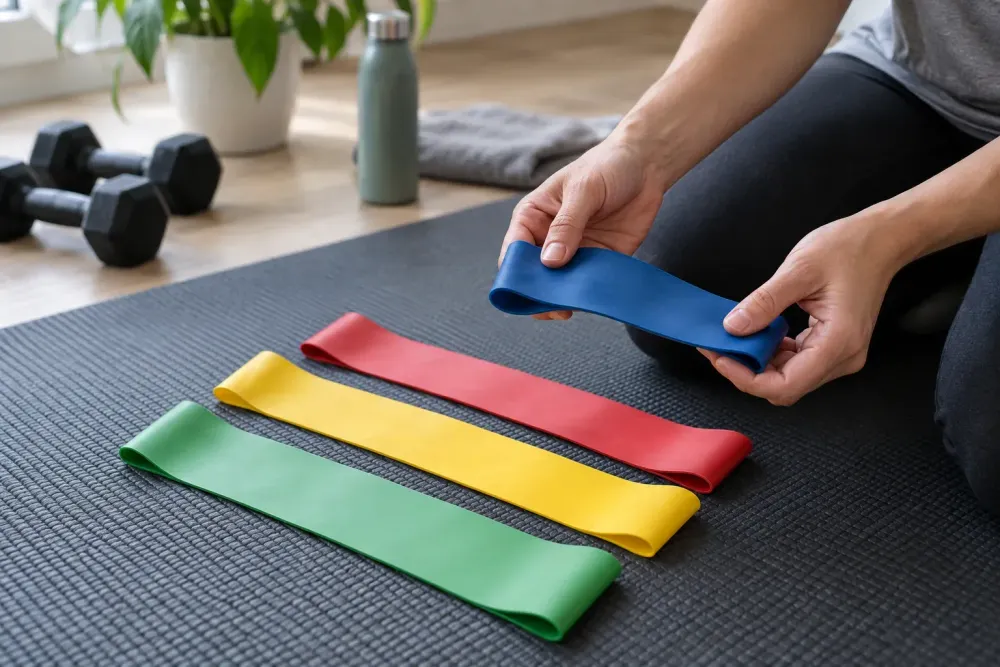
Resistance bands can build strength, but progress is easier to judge when you repeat the same setup. Record which band you used, how you held it and the movement you performed. A color alone is a poor training record when you change products or shorten your grip.
Bands are a recognized form of muscle-strengthening activity. The 2026 ACSM update also supports home-based and elastic-resistance training as useful options for healthy adults; a gym full of machines is not a prerequisite (CDC; ACSM).
Cover illustration: Inspect the actual band before use and follow its manufacturer's setup limits. Colors in this illustration do not represent standardized loads.
Record the setup you can reproduce
For a seated row, for example, write down the band, starting position and repetitions, not only that you did rows. If you move farther away or hold a shorter length, you have changed the setup. You may feel more effort without being able to compare it directly with the prior session.
That is a practical reason to use consistent positioning while you learn. A photo of your own safe setup can help your record, provided it follows the equipment instructions. Ask a qualified trainer to check it when you are unsure. Our return-to-strength-training guide offers a modest starting structure.
Progress without sacrificing control
When the current movement feels manageable across repeated sessions, try a small change: another controlled repetition or the next suitable resistance in your product's range. Avoid changing exercise, band and repetition count together if you want to understand the result. This is a tracking approach, not a universal progression prescription.
NIDDK advises starting activity slowly and increasing gradually. That principle also applies to resistance at home. A band that pulls you out of position is not a useful upgrade simply because it feels harder (NIDDK).
Check the equipment before the set
Follow the manufacturer's inspection, anchoring and maximum-stretch instructions for your exact product. Do not use a damaged band or improvise an anchor from furniture that may move. Keep your face clear of the line of recoil and stop if an attachment shifts. These precautions should be checked before the exercise, not after resistance is already pulling on the anchor.
If a movement causes sharp pain or aggravates an injury, stop and seek appropriate advice. The fact that a band feels lighter than a dumbbell does not establish that the movement is suitable for you.
CDC's general health guidance includes strengthening all major muscle groups on at least two days a week. Build a routine that covers those groups rather than repeating only the exercise that happens to fit one band (CDC). Bring your equipment and training record to a coach or physical therapist if you need help choosing safe alternatives.
Frequently asked questions
Do bands count as muscle-strengthening exercise?
Yes. Resistance bands are one option listed in physical activity guidance. The exercise must challenge the muscles; owning a band is not the same as using it consistently.
Does a blue band always mean the same resistance?
Do not assume that across products. Use the manufacturer's specifications and record the exact band and setup rather than treating color as a standardized weight.
References
- ACSM Publishes Updated Resistance Training Guidelines · American College of Sports Medicine, 2026
- Adult Activity Overview · Centers for Disease Control and Prevention
- Tips for Starting Physical Activity · National Institute of Diabetes and Digestive and Kidney Diseases
Read next

Tired after every workout: check sleep before adding more training
A practical sleep check for men who lift, including when snoring, gasping or daytime sleepiness needs assessment rather than another supplement.

Strength training has stalled: what to check before changing programs
Use your training record to separate one bad session from a plateau, then change a manageable part of the plan without chasing soreness.

Sore after lifting: when to recover and when to stop
How ordinary soreness after an unfamiliar workout differs from pain that needs assessment, with practical decisions for the next session.