Do testosterone boosters work? What trials show
Most testosterone boosters do not reliably work. Here is what human trials show for common ingredients, the safety limits, and when to get tested.

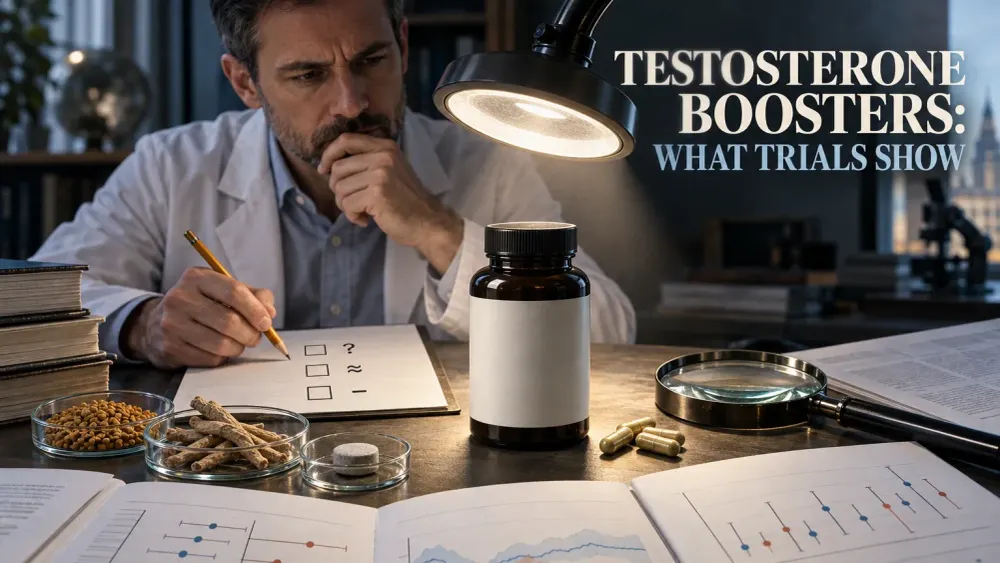
Short answer: most over-the-counter testosterone boosters do not reliably raise testosterone, and there is even less evidence that they produce a noticeable improvement in energy, mood, libido or erections. A few individual ingredients have shown positive results in small studies, usually in selected groups of men. That is not the same as proving that a multi-ingredient product works.
If you feel unusually tired, have less interest in sex or notice changes in strength or body composition, testosterone may be part of the picture. It may also be sleep loss, sleep apnea, excess weight, medication, depression or another health problem. Read our guide to what testosterone does and what counts as normal before treating a symptom as proof of a hormone deficiency.

What the trials say about testosterone boosters
The broadest recent review is a 2024 systematic review of 52 studies covering 27 proposed testosterone-boosting ingredients. Its main finding was simple: most did not increase total testosterone compared with placebo. The exceptions depended on the ingredient and the population. Results in athletes, men with late-onset hypogonadism, infertile men and healthy men were not interchangeable (International Journal of Impotence Research).
A separate analysis started with the five top-selling testosterone boosters on Amazon and traced their ten most common ingredients back to published research. The researchers found 191 studies, but only 37 involved humans. Among those human studies, 30% reported an increase in testosterone, 46% reported no effect, 3% found a decrease and the rest were inconclusive. The finished products themselves had little direct evidence behind them (The Journal of Sexual Medicine).
That distinction matters. A trial of one standardized extract at a stated dose does not validate a proprietary blend containing that ingredient. It also does not show that a small laboratory change will improve how a man feels. Most studies measured testosterone concentration; convincing evidence for meaningful improvements in energy, mood, libido or erectile function remains limited.

Ingredient-by-ingredient evidence
A 2021 systematic review of 32 randomized controlled trials evaluated 13 herbs. Nine trials reported a significant increase in testosterone, while six of those nine were judged to have a low risk of bias. Differences in extracts, doses and participants make the positive results hard to generalize (Advances in Nutrition).
| Ingredient | What the human evidence suggests | Practical verdict |
|---|---|---|
| Ashwagandha | Some small, short trials found higher total testosterone with specific extracts, often in selected groups rather than healthy men with confirmed normal levels. | Possible ingredient-specific effect; not reliable enough to call a general booster. |
| Fenugreek | Several trials reported increases, but preparations, doses and study populations differed. | Mixed evidence; one extract cannot validate every fenugreek product. |
| Tribulus terrestris | The herbal review found no significant difference from placebo in four trials. | Does not have persuasive evidence as a testosterone booster. |
| Maca | Trials did not show a meaningful increase in testosterone. | May be studied for other outcomes, but not supported as a testosterone booster. |
| D-aspartic acid | In resistance-trained men, 3 g daily did not raise testosterone; 6 g daily lowered total testosterone in one small trial. | No dependable benefit and no reason to choose a high dose. |
| Vitamin D | Results vary by baseline status. A randomized trial in healthy men with normal testosterone found no increase after 12 weeks. | Correct a diagnosed deficiency for health reasons; do not treat it as a universal booster. |
| Zinc | Deficiency can impair testosterone production, so correction may help when zinc status is low. | Useful for deficiency, not evidence that extra zinc raises a normal level. |
The useful pattern is not “natural versus synthetic.” It is whether a defined ingredient was tested at a defined dose in people like you, whether the result was repeated, and whether the change improved a symptom that mattered.
Ashwagandha and fenugreek: the most defensible options, with limits
Ashwagandha
Ashwagandha has enough human research to deserve a more careful answer than either “it works” or “it is useless.” Some trials found an increase in testosterone, but they were small, short and often enrolled stressed, overweight, infertile or resistance-trained men. Different extracts are not automatically equivalent. The evidence does not establish a predictable testosterone benefit for a healthy man with normal levels.
Safety deserves equal space. The National Center for Complementary and Integrative Health says ashwagandha may be safe for up to three months, while long-term safety remains uncertain. Reported effects include drowsiness, stomach upset, diarrhea and vomiting. Rare cases of liver injury have been linked to supplements. It is not recommended for people with thyroid or autoimmune disorders and can interact with medicines, including drugs for diabetes, blood pressure, seizures, thyroid disease and immune suppression (NCCIH).
Fenugreek
Fenugreek also has some positive trials, but the studies used different standardized extracts and enrolled different groups. That means “fenugreek” on a front label does not tell you whether the product resembles the preparation used in a positive trial.
NCCIH lists diarrhea, nausea and other digestive symptoms among potential adverse effects. Large doses can cause a harmful drop in blood sugar, and allergic reactions can be serious. Fenugreek can also interact with medicines. Anyone using glucose-lowering treatment or managing an allergy risk should discuss it with a clinician or pharmacist before taking a concentrated extract (NCCIH).
Zinc and vitamin D correct deficiencies; they do not reliably boost normal levels
Zinc and vitamin D belong in a different category from herbal extracts. Both nutrients matter to normal physiology. If you are deficient, correcting that deficiency is sensible. If your status is already adequate, taking more does not create an unlimited hormonal effect.
For adults, the tolerable upper intake level for zinc is 40 mg a day from all sources unless a clinician is supervising treatment. Long-term excess can contribute to low copper status and other problems. The adult upper limit for vitamin D is 4,000 IU (100 mcg) a day unless a clinician prescribes a different dose. Check the complete daily total when a booster is stacked with a multivitamin or separate vitamin D or zinc product (NIH Office of Dietary Supplements: zinc; vitamin D).
Food is most useful when it closes a real nutrient gap. Our guide to foods and testosterone separates deficiency correction from claims that an individual food can raise an already normal level.
FDA regulation and the label problem
Dietary supplements are not approved by the FDA for safety and effectiveness before they are sold. Companies are responsible for making sure their products comply with the law. In many cases a company can market a supplement without notifying the FDA; a premarket notification is required for certain new dietary ingredients. Much of the FDA's enforcement work therefore happens after a product reaches consumers (FDA).
This does not mean that 89% of all muscle-building supplements contain steroids. The widely repeated figure came from a study of products that had already been identified through FDA warnings as containing unapproved pharmaceutical ingredients. Within that selected set, researchers found synthetic steroids or steroid-like ingredients in 82 of 92 muscle-building supplements. The study is strong evidence that undeclared ingredients occur in the adulterated-product record, but it cannot estimate the prevalence across every testosterone booster on the market (JAMA Network Open).
A label can still create ordinary problems without hidden drugs. Proprietary blends may conceal individual doses. Several products can push the total amount of zinc or vitamin D above an upper limit. Herbal ingredients can interact with prescription medicines. A third-party certification can verify aspects of identity and manufacturing, but it does not prove that a booster raises testosterone or relieves symptoms.
How low testosterone is actually diagnosed
A symptom alone is not a diagnosis, and neither is one borderline afternoon test. The Endocrine Society recommends diagnosing hypogonadism only in men who have compatible symptoms or signs and consistently low testosterone. It recommends confirming a low result with a repeat morning fasting total testosterone measurement using an accurate assay (Endocrine Society).
The American Urological Association also calls for two total testosterone measurements on separate early mornings. Its guideline states that a total testosterone level below 300 ng/dL is a reasonable cutoff that supports the diagnosis when symptoms or signs are also present (AUA). Laboratories and clinicians also consider context, including illness, sleep, medication, obesity, fertility plans and conditions that affect sex hormone-binding globulin.

What to do instead of buying a testosterone booster
- Write down the symptom and its timing. Low libido, fewer spontaneous erections, loss of body hair, reduced testicular size and unexplained anemia carry different weight from general tiredness. Our guide to signs of low testosterone explains the difference.
- Arrange properly timed testing. If symptoms fit, ask for an early-morning total testosterone test and repeat a low result on a separate morning. Do not use a booster while trying to establish a clean baseline unless your clinician says otherwise.
- Look for the cause. Poor sleep, sleep apnea, obesity, heavy alcohol use, acute illness and some medicines can affect symptoms or hormone levels. Treating the driver is more useful than masking it.
- Correct a documented nutrient deficiency directly. Use a dose matched to the deficiency instead of a broad proprietary blend.
- Discuss treatment after the diagnosis is confirmed. Evidence-based treatment is a clinical decision that also considers fertility, prostate and cardiovascular history, hematocrit and the cause of the deficiency.

The practical verdict is straightforward. Tribulus, maca and D-aspartic acid do not have persuasive evidence as testosterone boosters. Ashwagandha and fenugreek have limited, ingredient-specific evidence, but neither is a dependable substitute for diagnosis. Zinc and vitamin D should be used to correct a real need, within a safe total daily dose. If you are worried about low testosterone, the first useful purchase is not a three-month blend. It is the right evaluation.
Frequently asked questions
Do testosterone boosters raise testosterone?
Most over-the-counter testosterone boosters do not reliably raise total testosterone. A 2024 systematic review covering 52 studies and 27 proposed boosters found that most failed to outperform placebo. A few ingredients produced positive results in specific groups, but that does not show that a mixed commercial formula will improve symptoms.
Does ashwagandha raise testosterone?
Possibly in some men, but the evidence is limited. Small, short trials have reported increases with certain preparations, often in stressed, overweight, infertile, or resistance-trained participants. The studies do not establish a predictable benefit for healthy men with normal testosterone, and they provide little evidence of a noticeable change in energy, libido, mood, or erections.
Are testosterone boosters safe?
You cannot assume that every booster is safe. Supplements are not approved by the FDA for safety and effectiveness before sale, ingredients can interact with medicines, and excessive zinc or vitamin D can cause harm. An FDA warning database study also found undeclared steroids or steroid-like substances in 82 of 92 muscle-building supplements already identified as adulterated; that finding does not describe 89% of all products on the market.
What should I do if I think my testosterone is low?
Start with symptoms and properly timed blood tests, not a supplement. The Endocrine Society recommends confirming a low result with a repeat morning fasting total testosterone measurement. The American Urological Association uses two separate early-morning measurements and considers total testosterone below 300 ng/dL a reasonable diagnostic cutoff alongside compatible symptoms and signs. A clinician can then look for the cause and discuss treatment.
References
- Testosterone boosters: a systematic review of 52 studies and 27 proposed ingredients · International Journal of Impotence Research, 2024
- Testosterone Imposters: An Analysis of Popular Online Testosterone Boosting Supplements · The Journal of Sexual Medicine, 2019
- Examining the Effects of Herbs on Testosterone Concentrations in Men: A Systematic Review · Advances in Nutrition, 2021
- Three and six grams supplementation of d-aspartic acid in resistance trained men · Journal of the International Society of Sports Nutrition, 2015
- FDA 101: Dietary Supplements · U.S. Food and Drug Administration
- Unapproved Pharmaceutical Ingredients Included in Dietary Supplements Associated With FDA Warnings · JAMA Network Open, 2018
- Testosterone Therapy for Hypogonadism Guideline Resources · Endocrine Society
- Testosterone Deficiency Guideline · American Urological Association
- Zinc Fact Sheet for Consumers · NIH Office of Dietary Supplements
- Vitamin D Fact Sheet for Consumers · NIH Office of Dietary Supplements
- Ashwagandha: Usefulness and Safety · NCCIH
- Fenugreek: Usefulness and Safety · NCCIH
Read next

Creatine and coffee: does caffeine cancel the benefit?
Trials do not support a simple rule that coffee cancels creatine. Understand the limits of the evidence and how to avoid stacking stimulants.
Creatine forms compared: monohydrate, HCl, buffered and the rest
What each form claims, how much direct evidence it has against monohydrate, what the 2024 and 2025 HCl trials found, and how to compare price per gram.

How much water should you drink on creatine?
There is no creatine-specific water target. What creatine does to your body water, why the scale moves in week one, and what the cramping trials found.