Why am I always tired? A man's guide to working out the cause
Persistent tiredness in men can reflect sleep, medicines, mood or medical conditions. When to seek care and how clinicians choose which tests may help.

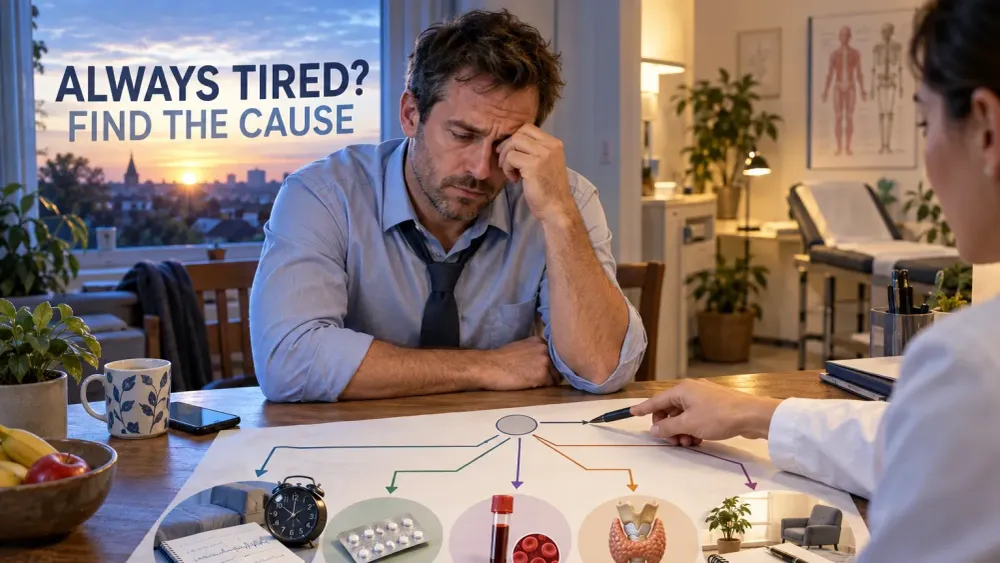
Feeling sleepy and feeling fatigued are not quite the same problem. Sleepiness is the urge to fall asleep. Fatigue is a lack of physical or mental energy, even when you are not nodding off. Men often use “tired” for both, and the distinction helps a clinician decide where to look first.
A few short nights can explain a rough week. Persistent tiredness that has no clear cause, affects daily life or arrives with other symptoms deserves a medical assessment. There is no universal fatigue blood panel, and supplements are not a substitute for finding the cause.
Start with the pattern, not a diagnosis
Write down what “tired” means in your case. Are you fighting sleep in meetings or while driving? Do your muscles feel heavy? Is concentration the main problem? Does activity make you feel worse for hours or days? Did the change begin suddenly, or has it crept up over months?
Also note when you feel worst, how many hours you actually sleep, whether you wake refreshed, and what changed around the time the problem began. New medicines, pain, shift work, a recent infection, more alcohol, lower mood and a jump in training load can all matter.
If you are becoming sleepy while driving, stop driving. UK rules say you must not drive until excessive sleepiness is controlled. Whether you must tell the DVLA depends on the diagnosis, severity and duration, so check the current GOV.UK guidance or ask your clinician.
Sleep quantity and sleep quality are different questions
Not getting enough sleep is common, but time in bed does not guarantee restorative sleep. Obstructive sleep apnoea/hypopnoea syndrome (OSAHS) repeatedly narrows or closes the upper airway during sleep. A man may not remember waking and can still feel unrefreshed the next day.
NICE advises assessing for OSAHS when several features fit, such as loud snoring, witnessed pauses in breathing, choking during sleep, unrefreshing sleep, waking headaches, unexplained sleepiness or fatigue, nocturia, fragmented sleep or cognitive problems. Snoring alone does not establish the diagnosis (NICE NG202).
- Ask a partner whether they hear pauses, gasping, choking or very loud snoring.
- Record morning headaches, dry mouth, repeated night-time urination and unrefreshing sleep.
- Tell a clinician if you fall asleep unintentionally during the day.
- Do not use a smartwatch or phone app to rule sleep apnoea in or out.
OSAHS is associated with hypertension and increased cardiovascular risk. That does not mean every tired man has sleep apnoea, but a compatible symptom pattern is worth discussing rather than treating with caffeine alone.

Check habits and medicines without delaying care
Alcohol can make it easier to fall asleep while disrupting the quality of the later night. Caffeine can still affect sleep hours after it is consumed. The NHS notes that caffeine may remain active for up to seven hours, so afternoon or evening coffee can matter (NHS).
A short, practical experiment can help if your symptoms are mild and there are no warning signs: keep a regular wake time, reduce alcohol, move caffeine earlier, and protect enough time for sleep. Record what changes. This is a way to identify contributors, not a test that clears you of a medical condition.
Review every medicine and supplement with a pharmacist or clinician. Sedating antihistamines, some pain medicines, certain antidepressants and other drugs can contribute to sleepiness or fatigue. Do not stop prescribed treatment abruptly to see what happens.

Medical causes are chosen from the rest of the picture
The NHS advises seeing a GP when tiredness has lasted a few weeks without a clear explanation, affects daily life, or comes with other symptoms such as weight loss or mood changes (NHS). A clinician will use your history and examination to decide whether tests are useful.
| Possible investigation | What it can help assess | Clues that may make it relevant |
|---|---|---|
| Full blood count, sometimes ferritin | Anaemia and possible iron deficiency | Breathlessness, palpitations, pallor, bleeding or dietary risk |
| HbA1c or blood glucose | Diabetes or abnormal blood glucose | Thirst, urinating more, unexplained weight change or blurred vision |
| TSH, with FT4 when indicated | Thyroid dysfunction | Feeling cold, constipation, weight change, dry skin or poor concentration |
| Morning testosterone, followed by confirmation if low | Possible testosterone deficiency | Compatible sexual, reproductive or physical signs, or relevant medical circumstances |
| Other targeted tests | Liver, kidney, inflammation, infection or another suspected cause | Chosen from symptoms, examination, medicines and medical history |
This table is not a shopping list. Normal results do not prove that fatigue is harmless, and broad private panels can create incidental findings without answering the original question.
Iron deficiency anaemia in a man needs a cause
Iron deficiency anaemia can cause fatigue, breathlessness, palpitations and pale skin (NHS). The next question is why it developed.
British Society of Gastroenterology guidance states that about one third of men and postmenopausal women presenting with confirmed iron deficiency anaemia have an underlying pathological abnormality, most commonly in the gastrointestinal tract. The guidance supports investigation of the cause, which can include coeliac screening and gastrointestinal assessment depending on the case (BSG guideline).
That figure applies to confirmed iron deficiency anaemia in the group described. It should not be applied to every borderline ferritin result. Do not start iron indefinitely without discussing the result and its cause with a clinician.
Thyroid testing usually starts with TSH
Hypothyroidism can cause fatigue, feeling cold, weight gain, constipation, low mood and difficulty concentrating, but one symptom alone is not enough to diagnose it. For most adults in whom secondary thyroid dysfunction is not suspected, NICE recommends measuring TSH first. FT4 is added when TSH is outside the reference range; TSH and FT4 are measured together when a pituitary or other secondary cause is suspected (NICE NG145).
Tell the clinician about biotin supplements because high intake can distort some thyroid test results.
Testosterone is one possible explanation, not the default
Fatigue can occur with testosterone deficiency, but it is not specific. Testing may be reasonable when the wider clinical picture suggests hypogonadism, including sexual or reproductive symptoms, loss of body hair, reduced testicular size, unexplained anaemia, low bone density, pituitary disease or other relevant circumstances.
The Endocrine Society recommends diagnosing hypogonadism only when compatible symptoms or signs occur with unequivocally and consistently low testosterone. A low result should be confirmed with another morning fasting measurement, and the cause should then be investigated (Endocrine Society). Our guides explain the symptom patterns linked with low testosterone and how a testosterone blood test is interpreted.
Mood, pain and recovery also count
Depression and prolonged stress can feel intensely physical. Men may report irritability, poor concentration, early waking, loss of interest or a sense that every task takes more effort before they describe sadness. Saying this plainly during an appointment changes the assessment.
Pain can fragment sleep. A recent infection can leave a long recovery. Shift work can keep the body clock out of step with the timetable. Training can exceed recovery, especially when food intake and sleep fall at the same time. None of these explanations should be dismissed because a basic blood test is normal.
When tiredness needs urgent help
Call emergency services now
- Severe difficulty breathing, gasping, choking or being unable to get words out
- A tight or heavy chest, or chest pain that may spread to the arm, jaw, back or stomach
- Fainting with failure to recover fully, difficulty speaking or moving, or chest pain
- Heavy or continuous rectal bleeding, or a large amount of blood
These can indicate an emergency. In the UK, call 999 or go to A&E. NHS guidance treats severe breathing difficulty and chest pressure or heaviness as emergencies (NHS breathlessness guidance; NHS heart attack guidance).
Seek prompt medical advice
- Black or dark-red stool, or blood in the stool
- Unintentional weight loss
- Drenching night sweats that repeatedly wake you
- A new or growing lump
- Breathlessness that is new, worsening or occurring with ordinary activity
- Tiredness with marked thirst and frequent urination
The right timing depends on severity and context. Use NHS 111 for urgent advice in the UK if you are unsure where to go.
Make the appointment more useful
Bring a concise record rather than trying to reconstruct the last month in the room:
- When the problem began and whether it is sleepiness, fatigue or both
- Bedtime, wake time, night waking and whether sleep feels restorative
- Snoring, witnessed pauses, gasping or choking
- Alcohol, caffeine and shift pattern
- Prescription medicines, over-the-counter medicines and supplements
- Weight, appetite, thirst, urination, bowel changes, mood and sexual symptoms
- Recent infection, pain, training changes and anything that reliably improves or worsens it

Tiredness is a symptom, not a diagnosis. The useful sequence is to describe the pattern, check obvious contributors, recognise warning signs and let the clinical picture guide any tests. Persistent or disruptive symptoms deserve an assessment even when no single cause seems obvious.
Correction: an earlier version of this guide presented a broad group of blood tests as a standard workup and overstated how often sleep apnoea explains tiredness in men. The article now states that tests are selected from the history, examination and associated symptoms, and it no longer applies a single prevalence estimate to all men. The change is recorded on our corrections page.
Frequently asked questions
When should constant tiredness be assessed by a doctor?
See a GP if tiredness has lasted a few weeks without a clear explanation, affects daily life, or comes with other symptoms such as weight loss or mood changes. Seek help sooner when symptoms are severe or a warning sign is present.
Which blood tests might a doctor consider for persistent tiredness?
There is no universal fatigue panel. Depending on the history and examination, a clinician may consider a full blood count, ferritin, blood glucose or HbA1c, and thyroid tests, with other tests chosen for specific clues. Testosterone testing is useful when symptoms, signs or medical circumstances make deficiency plausible.
Could tiredness be caused by sleep apnoea?
Yes, especially when tiredness or sleepiness occurs with loud snoring, witnessed pauses in breathing, choking during sleep, waking headaches or unrefreshing sleep. Several features together justify assessment; snoring alone does not diagnose sleep apnoea.
Can low testosterone cause fatigue?
It can, but fatigue alone is not specific for testosterone deficiency. Diagnosis requires a compatible clinical pattern and consistently low testosterone on properly timed blood tests. A clinician may test when sexual, reproductive or physical signs, or relevant medical circumstances, make deficiency plausible.
References
- Why am I tired all the time? · NHS
- Self-help tips to fight fatigue · NHS
- Obstructive sleep apnoea/hypopnoea syndrome and obesity hypoventilation syndrome in over 16s · NICE NG202
- Thyroid disease: assessment and management · NICE NG145
- Iron deficiency anaemia · NHS
- British Society of Gastroenterology guidelines for the management of iron deficiency anaemia in adults · Gut, 2021
- Testosterone Therapy for Hypogonadism Guideline Resources · Endocrine Society
- Symptoms of type 2 diabetes · NHS
- Excessive sleepiness and driving · GOV.UK
- Shortness of breath · NHS
- Symptoms of a heart attack · NHS
- Fainting · NHS
- Bleeding from the bottom · NHS
- Unintentional weight loss · NHS
- Night sweats · NHS
- Lumps · NHS