The US Navy body fat formula: how accurate it is, and what the Navy uses now
Online calculators still run the old neck-and-waist equation. How well it performed against laboratory methods, and what the Navy measures instead now.

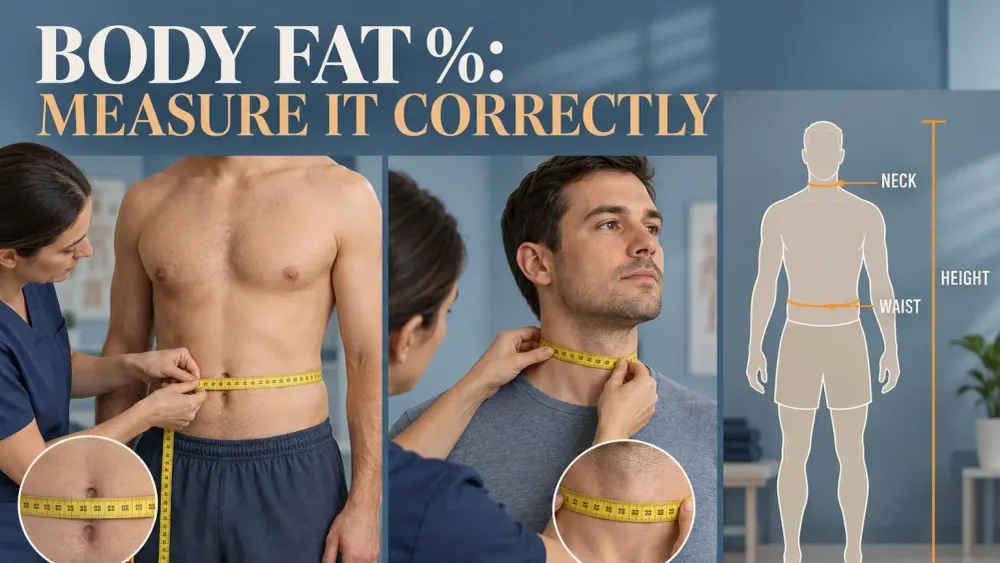
Type your neck, abdomen and height into an online US Navy body fat calculator and it returns a precise-looking percentage. That result comes from a historical male circumference equation. It is not the Navy’s current Body Composition Assessment, and the decimal display should not be mistaken for measured precision.
The MyNavyHR Physical Readiness page currently lists OPNAVINST 6110.1L CH-1 and a Guide 4 dated June 2026; the page marks the Guide 4 update as July 1, 2026. NAVADMIN 264/25 announced a two-step BCA. Height, weight and waist at the navel are collected for all Sailors. Step 1 is a waist-to-height-ratio screen with the same 0.5499 cut-off for men and women. Sailors above that threshold proceed to Step 2. For men, Step 2 uses height minus waist and weight tables, with a maximum allowable body-fat value of 26%. Neck circumference and the Hodgdon-Beckett neck-and-abdomen equation are not inputs to the current BCA.
What the Navy actually does now
The official MyNavyHR Physical Readiness page currently lists OPNAVINST 6110.1L CH-1 and Guide 4. Guide 4 is dated June 2026, while the page labels its update July 1, 2026. NAVADMIN 264/25 announced the two-step BCA.
Guide 4 says height, weight and waist at the navel are collected for all Sailors. For Step 1, height is rounded up and waist down to the nearest half inch; the waist-to-height ratio is truncated to four decimals. A result of 0.5499 or less passes Step 1 for men and women. Sailors above that threshold proceed to Step 2. For men, Step 2 uses the height-minus-waist difference and weight tables, with a maximum allowable body-fat value of 26%. The maximum for women is 36%.
The current BCA inputs do not include neck circumference, so the older abdomen-minus-neck equation used by many online calculators is not the current BCA calculation. That limited statement does not claim the historical equation appears nowhere else in Navy history or research.
| Method | Inputs described here | Status |
|---|---|---|
| Hodgdon-Beckett male estimate | Height, abdomen at the navel, neck | Legacy equation implemented by this site’s calculator |
| Current BCA Step 1 | Height and waist | Ratio truncated to four decimals; 0.5499 or less passes |
| Current BCA Step 2 | For men: height minus waist and weight tables | Step 2; maximum allowable value 26% for men |
Our body fat calculator reports a rounded legacy-equation estimate, not a current Navy BCA result, laboratory measurement, uncertainty range or pass/fail decision.
What the classic formula measures
For men, the historical equation uses height, abdomen at the navel and neck. The calculator uses the published metric body-density form and then applies the Siri conversion. Rounded direct-inch coefficients published elsewhere are not numerically identical at every input.
Hodgdon and Beckett’s 1984 Naval Health Research Center report studied 602 male Navy personnel aged 18 to 56 against underwater weighing. Its often-repeated 3.99-point standard error describes validation of the older Wright equation, not the final Hodgdon-Beckett equation. These are study statistics, not personal plus-or-minus bands.
How accurate is the Navy body fat formula?
Moon and colleagues compared field and laboratory estimates with a three-compartment reference model in 31 Caucasian college-age men. For the Navy/Air Force equation, the standard error of estimate was 3.96 percentage points, total error was 5.2 points, and reported 95% limits of agreement ran from -11.60 to 5.87 points (Dyn Med, 2008).
Those numbers describe a small, narrow sample. Total error is not a confidence interval for an individual result, and neither 5.2 nor 3.96 should be displayed as your error margin.
DXA, air-displacement plethysmography, bioimpedance and skinfolds also depend on the device, equation, population and protocol. Group agreement or a study error statistic does not create individual precision.
What an eight-week recruit study found
Foulis and colleagues followed 1,407 healthy Army trainees, including 926 men aged 17 to 42, across an eight-week Basic Combat Training course. Measurements were taken in weeks 1 and 9. Among the men, baseline circumference-estimated body fat averaged 16.7% and DXA 22.8%; the baseline difference was -6.0 points. Across training, DXA changed by -3.3 points and the circumference estimate by -2.2 points. The method classified the direction of a gain or reduction of at least one point correctly in about 83% of the men (Front Physiol, 2023).
Participants were selected enlistees; hydration was not controlled; DXA took place later after food; and the same tape measurer was not always available. This is a cohort-specific comparison, not a guaranteed personal tracking accuracy or schedule.

Those figures describe this one recruit cohort, not a rule for an individual. They do not show that the direction will be classified correctly, or that the size will differ from DXA, for every user.
A larger change may be easier to distinguish from measurement variation, but the study did not establish a universal cadence or personal least-detectable change. Compare repeated readings only when method and conditions are kept as consistent as practical.
What counts as a healthy body fat percentage
There is no single universally accepted clinical classification that turns a man's estimated body fat percentage into a diagnosis.
When researchers set out to build body fat ranges in 2000, they opened by noting that no accepted published ranges existed, and that empirical limits, population percentiles and z-scores all had serious limitations. Their solution was to work backwards from established BMI guidelines to predicted body fat (Am J Clin Nutr, 2000).
That was one reasonable way to propose ranges rather than a universal standard. So when a calculator labels 18% "fitness" and 25% "average", it is presenting one classification as a verdict, on top of an input that is itself an estimate.
A separate screen for central adiposity
NICE NG246 recommends waist-to-height ratio alongside BMI for adults with BMI below 35 kg/m². Its central-adiposity bands are not body-fat-percentage categories.
NICE places the tape midway between the bottom of the ribs and top of the hips, just above the belly button, after a natural exhalation. The legacy male equation uses abdomen at the navel. Do not apply NICE labels directly to that navel input; use the dedicated waist-to-height calculator with the NICE landmark.
Navy BCA and NICE answer different questions: an administrative military assessment versus a clinical central-adiposity screen.
When to take it to a doctor
A calculator estimate does not diagnose a health problem. Seek clinical advice for unintentional weight loss, persistent weakness, or concern about a sustained change in waist or weight.
Blood pressure, glucose measures and lipids can inform cardiometabolic risk, but they do not settle whether a body-composition change was fat or muscle. A clinician can interpret them with BMI, a correctly measured waist and your history.
Frequently asked questions
Is the online Navy body fat formula still what the Navy uses?
No. This calculator uses the legacy Hodgdon-Beckett male circumference estimate based on height, abdomen at the navel and neck. The current Guide 4 is dated June 2026 and is listed by MyNavyHR in an update marked July 1, 2026. It collects height, weight and waist at the navel for a two-step BCA; neck and the legacy equation are not current BCA inputs.
How accurate is the classic Navy formula?
It is a rough estimate, not a precise personal measurement. In Moon et al.’s sample of 31 Caucasian college-age men, the Navy/Air Force equation had a standard error of estimate of 3.96 points, total error of 5.2 points and 95% limits of agreement from -11.60 to 5.87 points. These are sample statistics, not a personal plus-or-minus interval.
Can I use it to track fat loss?
It may help describe a trend when the same method is repeated under similar conditions, but no result is guaranteed. In 926 selected male Army recruits, the circumference assessment classified the direction of a change of at least one point correctly in about 83% over eight weeks; hydration and measurer continuity were not controlled.
What is a healthy body fat percentage for a man?
There is no single universally accepted clinical classification for men. Published ranges depend on method, age, population and outcome; Gallagher and colleagues mapped predicted body fat to BMI categories. NICE waist-to-height bands are central-adiposity categories, not body-fat percentages, and apply alongside BMI in adults with BMI below 35 using NICE’s own waist landmark.
Read next

Tired after every workout: check sleep before adding more training
A practical sleep check for men who lift, including when snoring, gasping or daytime sleepiness needs assessment rather than another supplement.
Getting stronger with resistance bands: track more than the color
Make a home band workout repeatable, know when to progress it, and check the equipment without treating a color as a universal weight.

Strength training has stalled: what to check before changing programs
Use your training record to separate one bad session from a plateau, then change a manageable part of the plan without chasing soreness.