How to raise testosterone naturally: what the evidence supports
How to confirm low testosterone and address weight, sleep, alcohol, medicines and deficiencies without relying on unsupported booster claims.


There is no single food, workout or supplement that reliably raises testosterone in every man. The useful approach is to confirm whether the level is actually low, look for a reversible cause and improve the health problems that commonly travel with low testosterone.
That distinction matters because fatigue, low mood, reduced libido, erectile problems and loss of strength have many possible causes. Treating the number without checking the wider picture can delay the diagnosis that actually explains the symptoms.
Key takeaways
- Low testosterone is diagnosed from symptoms or signs plus consistently low laboratory results, not from one number.
- The Endocrine Society recommends two separate morning, fasting total-testosterone measurements. The American Urological Association uses below 300 ng/dL as a reasonable cut-off that supports the diagnosis.
- For men carrying excess body fat, sustained weight loss has the clearest evidence for improving testosterone.
- Sleep, exercise, reduced heavy alcohol use and treatment of underlying illness are valuable for health, but the testosterone response varies.
- CPAP treats obstructive sleep apnoea, yet pooled trials have not shown a reliable rise in testosterone from CPAP alone.
- Most commercial testosterone boosters do not reliably increase total testosterone. Correct a documented nutrient deficiency instead of guessing.
First confirm that testosterone is low
The Endocrine Society guideline defines hypogonadism as compatible symptoms or signs together with unequivocally and consistently low testosterone. Because levels vary from day to day and can be suppressed by food intake, it recommends measuring total testosterone on two separate mornings while fasting.
The American Urological Association guideline uses total testosterone below 300 ng/dL as a reasonable diagnostic cut-off, but the number is supporting evidence rather than a diagnosis on its own. Symptoms still matter, and both measurements should be taken early in the morning.
If a result is close to the lower limit, or if a condition changes sex hormone-binding globulin, a clinician may add free testosterone, SHBG or other tests. Our guides to the signs of low testosterone and the testosterone blood test explain what the first appointment and repeat testing may involve.

Look for reversible causes before chasing a higher number
Age affects testosterone, but age alone does not explain every low result. Excess body fat, acute or chronic illness, under-eating, sleep disruption, obstructive sleep apnoea and some medicines can all affect the result or the hormone system behind it. A clinician may also need to distinguish a problem originating in the testes from one involving the pituitary or hypothalamus.
Do not stop a prescribed medicine on your own. Bring a full medication and supplement list to the appointment, including non-prescription products. That makes it easier to identify a plausible cause without creating a new health problem.
Weight loss has the strongest lifestyle evidence
When a man has obesity and low testosterone, loss of excess weight is the lifestyle intervention with the most consistent evidence. A systematic review and meta-analysis found that both low-calorie diets and bariatric surgery were associated with increased testosterone, and larger weight loss was associated with a larger hormonal change (European Journal of Endocrinology, 2013).
A later meta-analysis of diet-induced weight loss also found increases in total testosterone, particularly when weight loss was greater (Obesity Reviews, 2023). These are group averages, not a promise for an individual. Baseline weight, the amount lost, health conditions and the cause of the low result all influence the response.
A practical plan is the one you can sustain: a moderate calorie deficit, enough protein, resistance training and regular activity. Track waist size and body weight as health measures rather than treating each fluctuation in testosterone as a verdict. The waist-to-height calculator can provide a simple starting measure.
Sleep matters, but the size of the testosterone effect is uncertain
A small laboratory study in healthy young men found that one week of sleeping less than five hours a night was followed by 10% to 15% lower daytime testosterone than measurements taken after rested nights (JAMA, 2011). This finding is often presented as proof that restoring sleep will raise testosterone by the same amount. The study did not test that claim.
Other controlled research has not always reproduced a fall with partial sleep restriction. A systematic review and meta-analysis concluded that total sleep deprivation lowers testosterone, while short-term partial sleep deprivation did not produce a statistically significant pooled effect (Sleep Medicine Reviews, 2021).
Aim for a sleep schedule that leaves you alert and functional, and discuss persistent insomnia, loud snoring, witnessed pauses in breathing or severe daytime sleepiness with a clinician. Better sleep is worthwhile even if a blood test barely changes.

Treat sleep apnoea for health, not as a testosterone hack
Obstructive sleep apnoea deserves assessment because it is linked with cardiovascular, metabolic and daytime-function risks. Continuous positive airway pressure can improve breathing during sleep and symptoms in appropriately selected patients.
It should not be sold as a reliable testosterone booster. A meta-analysis of 12 studies found a neutral effect of CPAP on total testosterone and gonadotropins in men with obstructive sleep apnoea (Frontiers in Endocrinology, 2019). Treat the apnoea because the condition matters, then assess persistent hormonal symptoms separately.
Exercise improves the conditions around testosterone
Resistance training can cause a temporary hormonal response after a session, but that does not mean resting testosterone will stay higher. A systematic review in insufficiently active older men found little consistent effect of short-term exercise training on basal testosterone (Frontiers in Physiology, 2019).
In men with obesity or type 2 diabetes, pooled research suggests aerobic training may increase testosterone modestly, although studies vary in design and quality (Sports Medicine - Open, 2024). Exercise can also help reduce fat mass, preserve muscle, improve fitness and support sleep. Those outcomes make training worthwhile without requiring a dramatic change in the laboratory result.
Use resistance training two or more days a week if your health and experience allow, and build aerobic activity gradually. Our guide to building muscle explains how to organise volume, effort and recovery.

Reduce heavy alcohol use
Alcohol does not have one simple, dose-independent effect on testosterone. Acute studies vary, while chronic heavy use can disrupt testicular and hypothalamic-pituitary function and is associated with lower testosterone and poorer reproductive health.
If drinking is frequent or heavy, reducing it is a reasonable part of the plan. The benefit is broader than a hormone result: sleep, blood pressure, liver health, mood and calorie intake may all improve. Men who may be dependent on alcohol should seek medical advice before stopping abruptly because withdrawal can be dangerous.
Ask for a medication review
Long-term opioids are a recognised cause of suppressed testosterone. Chronic systemic glucocorticoids can also contribute to testosterone deficiency. The correct response is a review with the prescriber, not suddenly stopping pain treatment or steroids.
A medication review should ask whether the drug is still needed, whether the dose can be reduced safely, whether an alternative exists and whether the symptoms require endocrine evaluation. The answer depends on the condition being treated and cannot be reduced to a general internet rule.
Correct confirmed deficiencies, not theoretical ones
Zinc, vitamin D and other nutrients are required for normal physiology, but taking more does not guarantee a higher testosterone level. The useful question is whether a deficiency has been demonstrated and why it developed.
In a randomised controlled trial of 98 healthy men with normal baseline testosterone, weekly vitamin D for 12 weeks did not increase total testosterone (Journal of Clinical Endocrinology & Metabolism, 2017). That does not make vitamin D unimportant. It means supplementation should be based on the nutrient problem it is intended to treat, not on a guaranteed hormonal effect.

Most testosterone boosters are a poor bet
Products marketed as testosterone boosters often combine herbs, vitamins and minerals in doses that make the label look scientific. The evidence rarely supports the implied result. A 2023 systematic review found that most studied products did not increase total testosterone, while evidence for several ingredients was conflicting or too limited for firm conclusions (World Journal of Men's Health, 2023).
That is a better summary than declaring that every ingredient always fails. Formulations, doses, populations and study quality differ. The practical problem remains: a proprietary blend cannot diagnose obesity-related suppression, sleep apnoea, medication effects, pituitary disease or primary testicular disease. Our testosterone boosters guide examines the common ingredients and the limits of the trials.
What if your testosterone is already normal?
Healthy habits can improve energy, body composition, sleep and sexual health without moving testosterone much. If repeat testing is normal, do not assume that a higher number is the missing treatment.
Persistent symptoms may come from depression or anxiety, medication effects, thyroid disease, anaemia, diabetes, cardiovascular disease, sleep disorders, relationship strain or other causes. That list is not a diagnosis. It is the reason a broader clinical assessment is more useful than repeatedly buying supplements or ordering isolated hormone panels.
When to see a clinician
Arrange an assessment if symptoms are persistent, worsening or affecting sexual function, fertility, mood, strength or daily life. Seek earlier care when symptoms are accompanied by testicular change, breast enlargement, severe headache, visual symptoms or another concerning sign.
Bring previous results, the time each sample was taken, recent illness, sleep history, medication and supplement lists, and your goals for fertility. A clinician can decide whether total testosterone should be repeated and whether free testosterone, SHBG, luteinising hormone, follicle-stimulating hormone, prolactin or other tests are appropriate.
There is no universal lifestyle countdown after which every man should retest. Timing depends on the suspected cause, the intervention, symptoms and the clinician's plan.

Frequently asked questions
What can raise testosterone naturally?
For men with obesity and low testosterone, sustained loss of excess weight has the strongest lifestyle evidence. Adequate sleep, exercise, reduced heavy alcohol use and treatment of underlying illness support health, but their effect on testosterone varies between individuals.
Does lifting weights raise testosterone?
A workout can cause a temporary hormonal response, but resistance training does not reliably produce a lasting rise in resting testosterone. Lift to build or preserve muscle, strength and metabolic health.
Does CPAP raise testosterone?
CPAP treats obstructive sleep apnoea, but a meta-analysis did not find a reliable increase in testosterone from CPAP alone. Treat sleep apnoea for its established health benefits and assess persistent hormonal symptoms separately.
When should testosterone be retested?
Diagnosis generally requires two separate early-morning measurements, and the Endocrine Society recommends fasting samples. Follow-up timing after a lifestyle or medication change should be set with the clinician evaluating the cause.
References
- Testosterone Therapy in Men With Hypogonadism: Endocrine Society Clinical Practice Guideline
- American Urological Association Testosterone Deficiency Guideline
- Body weight loss reverts obesity-associated hypogonadotropic hypogonadism: systematic review and meta-analysis
- Diet-induced weight loss and testosterone in men: systematic review and meta-analysis
- Effect of one week of sleep restriction on testosterone levels in young healthy men
- Effects of total and partial sleep deprivation on testosterone: systematic review and meta-analysis
- Effects of CPAP on testosterone levels in patients with obstructive sleep apnoea: meta-analysis
- Short-term exercise training and basal testosterone in older men: systematic review and meta-analysis
- Aerobic exercise training and testosterone in obesity or type 2 diabetes: systematic review and meta-analysis
- Vitamin D and testosterone in healthy men: randomised controlled trial
- Testosterone boosters: systematic review of ingredients and evidence
This article is for education and does not diagnose testosterone deficiency or replace individual medical care.
Read next

TRT explained honestly: who it helps, what it costs, what to ask
Testosterone replacement is a real treatment for a real diagnosis. What the trials show it does and does not fix, the trade-offs, and how to spot a bad clinic.
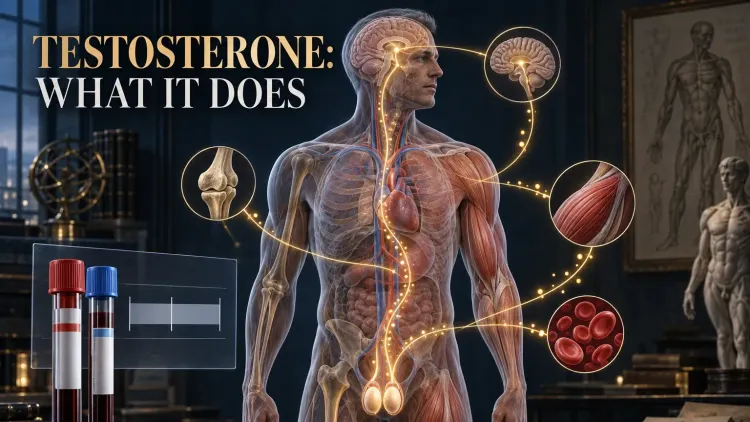
Testosterone: what it does, what is normal, and what really changes with age
Testosterone results need context. Learn what the hormone does, how total and free levels differ, what ranges mean and when repeat testing is useful.
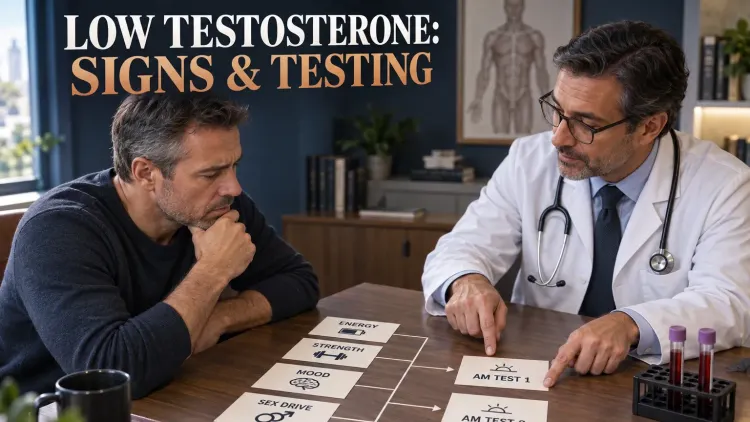
Signs of low testosterone: what they mean and when to get tested
The signs of low testosterone in men, why they are easy to misread, and how the diagnosis is confirmed. Test before you assume.