Testosterone: what it does, what is normal, and what really changes with age
Testosterone results need context. Learn what the hormone does, how total and free levels differ, what ranges mean and when repeat testing is useful.

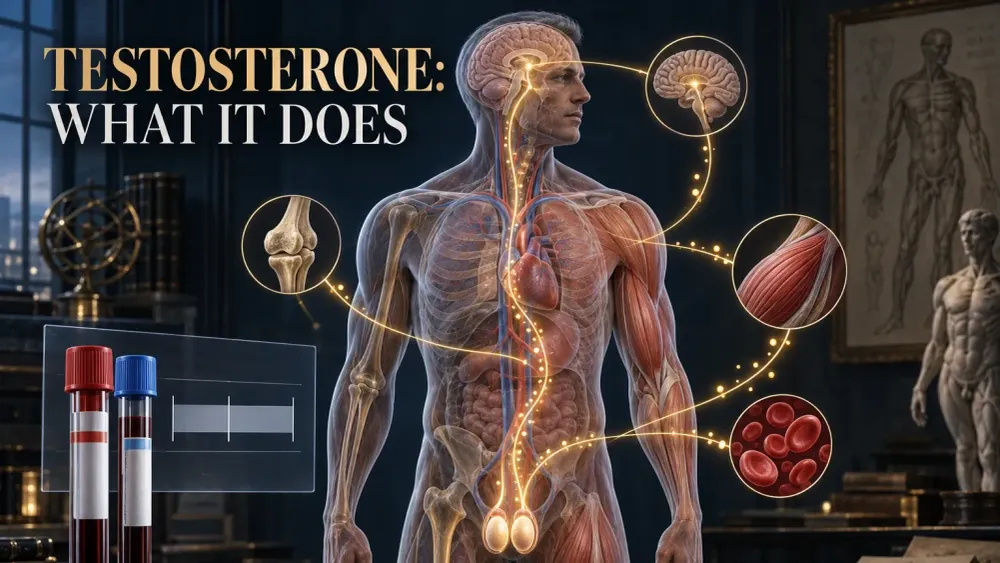
Testosterone is important, but one result does not measure masculinity, fitness or general health. The hormone supports sexual and reproductive function, bone and muscle, red blood cell production and several other systems. Its level also moves with time of day, health, weight, medicines and the proteins that carry it in blood.
That is why a useful testosterone assessment starts with symptoms and properly timed testing. It does not start with an online age chart or a target borrowed from someone else's laboratory report.
What testosterone does in adult men
Testosterone is made mainly in the testes. In adult men it helps maintain libido, sperm production, bone density, muscle mass, body-hair patterns and red blood cell production. It also influences fat distribution and sexual function. These effects overlap with many common health complaints, but that does not make testosterone the default explanation for tiredness, low mood, weight gain or a difficult workout.
Some findings are more suggestive of androgen deficiency than others. Reduced sexual desire, fewer spontaneous or morning erections, loss of body hair, small testes and unexplained low bone density deserve attention. Our guide to low testosterone symptoms and causes explains why the pattern matters more than one vague complaint. Fatigue and poor concentration can occur with low testosterone, but they are less specific and may come from sleep disorders, depression, acute illness, medicine effects or many other causes.
How the brain, pituitary and testes control production
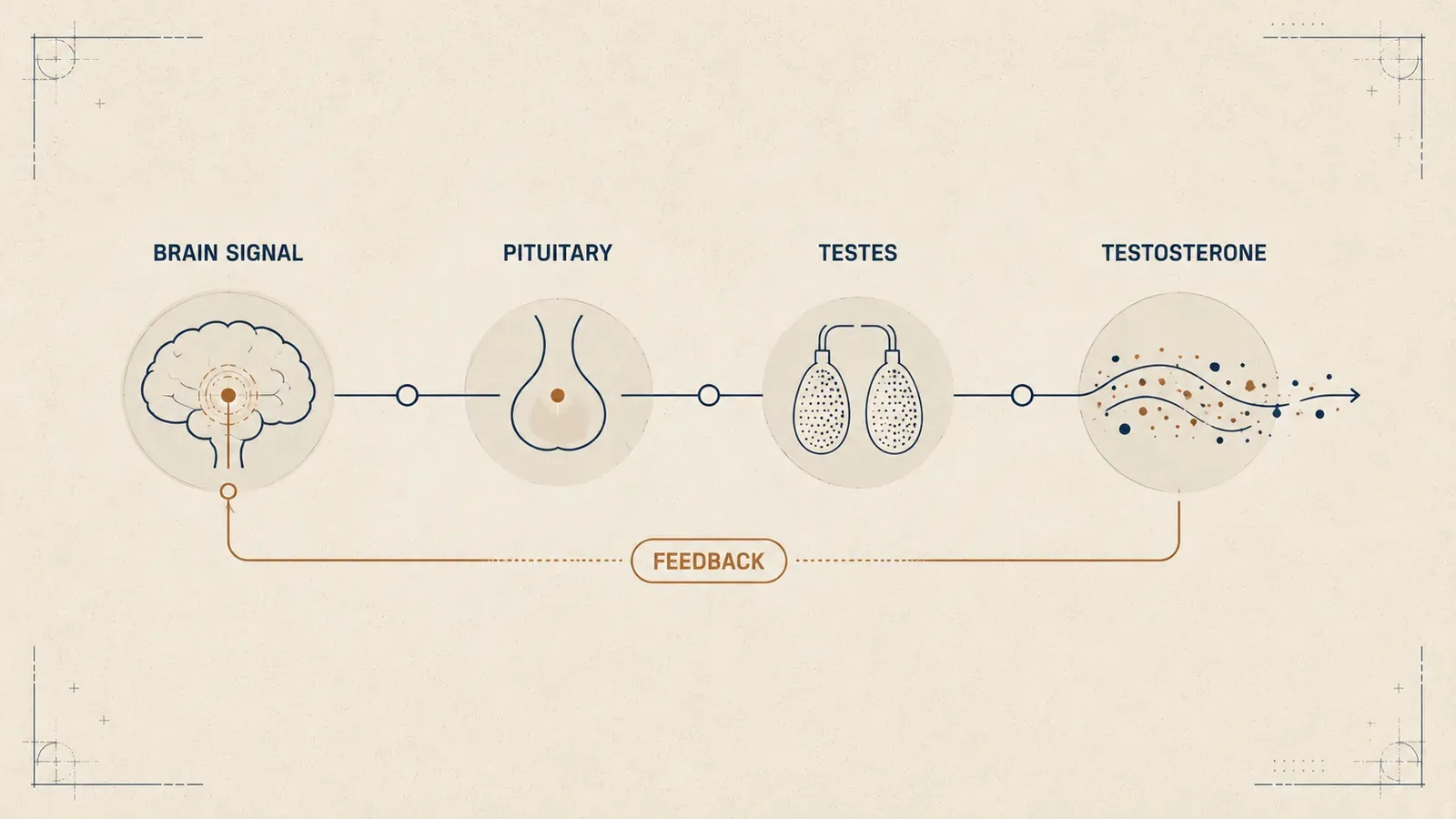
Testosterone production runs through the hypothalamic-pituitary-gonadal axis. The hypothalamus releases gonadotropin-releasing hormone, the pituitary releases luteinizing hormone (LH), and LH signals Leydig cells in the testes to produce testosterone. Testosterone then feeds back to the brain and pituitary to regulate the loop.
This is clinically useful. Low testosterone with a high LH level can point toward impaired testicular function. Low testosterone with a low or inappropriately normal LH level can point toward the hypothalamus or pituitary. The pattern still needs clinical interpretation; LH is not a home diagnostic shortcut.
Testosterone taken from outside the body can suppress this signaling and reduce sperm production. Fertility plans therefore belong in any discussion of testosterone replacement therapy.
Total, free, SHBG and albumin
A standard blood test usually reports total testosterone: free hormone plus testosterone carried by proteins. Sex hormone-binding globulin (SHBG) binds testosterone with high affinity. Albumin binds it more weakly. Free testosterone and the albumin-bound fraction are often grouped as bioavailable testosterone, because the albumin bond is comparatively easy to dissociate. It is inaccurate to describe all protein-bound testosterone as unavailable to tissues.
SHBG can change the relationship between total and free testosterone. Age, obesity, thyroid disease, liver disease, some medicines and other conditions may alter SHBG. A total result near the lower limit can therefore need more context. The Endocrine Society advises assessing free testosterone with an accurate method when total testosterone is close to the lower limit or when a condition that alters SHBG is present. Our testosterone blood test guide explains the timing and common follow-up tests.
There is no universal normal level for every age
A reference range describes values found in a defined reference population with a particular testing method. It is not a treatment target, and ranges are not interchangeable between assays or laboratories.
One useful benchmark comes from a harmonization study that aligned testosterone measurements across several cohorts. For healthy, non-obese men aged 19 to 39, the harmonized reference range was 264 to 916 ng/dL (2.5th to 97.5th percentile). That range is frequently quoted, but its limits matter: it was derived from younger, non-obese men and standardized assays. It is not a universal age table and cannot diagnose a man by itself (Travison and colleagues).
For suspected testosterone deficiency, the American Urological Association considers total testosterone below 300 ng/dL a reasonable cutoff supporting the diagnosis. The same guideline requires two measurements on separate early mornings and compatible symptoms or signs. The Endocrine Society likewise requires symptoms or signs plus unequivocally and consistently low testosterone, with a repeat morning fasting measurement to confirm a low result. A cutoff is diagnostic support, not a verdict from one blood draw.

What really changes with age
Population averages show lower testosterone at older ages, but the change is not a fixed percentage that applies to every man. Longitudinal data from 2,395 men aged 40 to 79 in the European Male Ageing Study found a small average annual decline in total testosterone alongside wide individual variation. Weight gain was associated with decreases in testosterone and SHBG, while weight loss was associated with increases (EMAS longitudinal study).
A separate EMAS analysis found that age, obesity and health status relate to different parts of the hormonal axis rather than producing one uniform pattern (EMAS risk-factor study). This is a better model than saying every man loses 1% or 2% each year after a particular birthday.
The practical point is not that age is irrelevant. It is that a result should be read in context. A substantial change may reflect weight change, acute or chronic illness, sleep disruption, medicines, a change in SHBG or a problem in the testes or pituitary. Our guide to supporting healthy testosterone without supplements focuses on modifiable factors without promising that lifestyle can correct every medical cause.
How low testosterone is diagnosed
The Endocrine Society recommends against routine screening of men in the general population. Testing makes sense when symptoms, signs or relevant medical circumstances create a reasonable suspicion of deficiency.
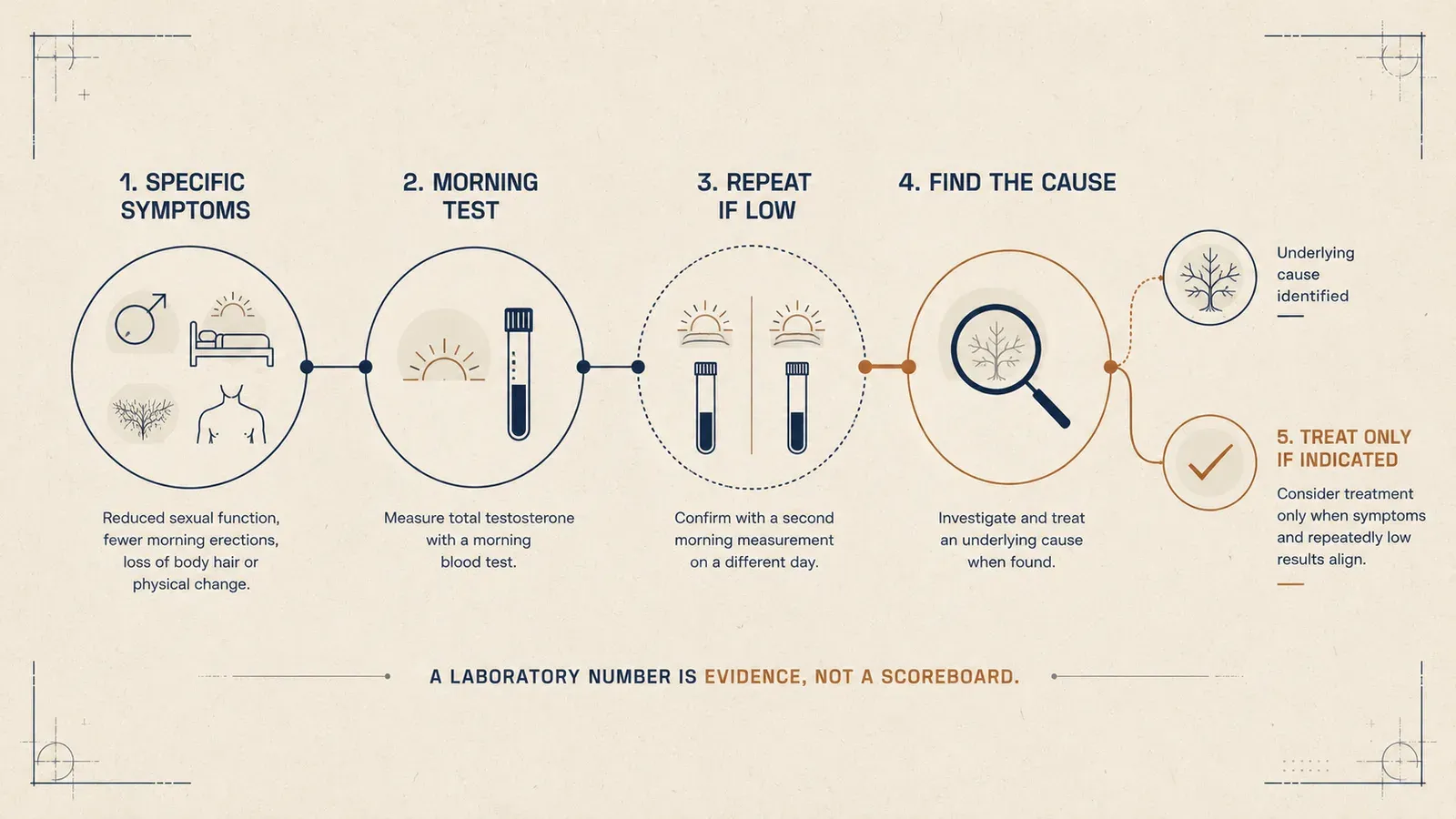
- Start with the clinical pattern. Record the symptom, when it began, medicines, recent illness, sleep, weight change and fertility plans.
- Measure total testosterone in the morning. Guideline timing reduces one common source of misleading results. The Endocrine Society specifies a morning fasting sample.
- Repeat a low result on another morning. Both major guidelines require confirmation rather than diagnosing from one result.
- Interpret the laboratory and the man together. Symptoms or signs and consistently low values must agree. Free testosterone or SHBG may help in selected cases.
- Investigate the cause. LH and sometimes additional tests help distinguish testicular causes from hypothalamic or pituitary causes before treatment is considered.
What low or high results can mean
A low result has several possible explanations. Causes can involve the testes, the pituitary or hypothalamus. Obesity, chronic disease, acute illness and certain medicines may also affect testosterone or its interpretation. A low number is therefore the start of an evaluation, not an automatic prescription.
A high result also needs context. In men, MedlinePlus lists steroid use, a testicular tumor and an adrenal disorder among possible causes. Prescribed testosterone can raise the result as well. Tell the clinician and laboratory about testosterone, anabolic steroids, supplements and medicines before the test. An unexpectedly high value deserves medical review rather than an assumption that it is beneficial.
If symptoms and repeat low results support a diagnosis, treatment depends on the cause, health history and fertility goals. Over-the-counter testosterone boosters do not replace that workup.
When to speak with a clinician
Arrange an evaluation if you have a persistent combination of sexual symptoms, fewer spontaneous erections, loss of body hair, reduced testicular size, unexplained anemia or low bone density. Ask for review if a testosterone result is below the laboratory range, repeatedly borderline with compatible symptoms, or unexpectedly high.
Routine testing to chase an “optimal” number is different. Current guidelines do not support screening every man without symptoms, and they do not define the top of a reference range as a health goal. The useful question is whether a consistent laboratory abnormality explains a real clinical problem and what caused it.
Frequently asked questions
What is a normal testosterone level?
There is no single range that fits every man, age and laboratory. A harmonization study found 264 to 916 ng/dL for healthy, non-obese men aged 19 to 39 using standardized assays. Use the reference range from the laboratory that performed your test and interpret it with symptoms, timing and clinical context.
Is testosterone below 300 ng/dL always low testosterone?
No. The AUA uses below 300 ng/dL as a reasonable cutoff supporting diagnosis, but diagnosis also requires compatible symptoms or signs and two total testosterone measurements on separate early mornings. The result may need added context from SHBG, free testosterone, health conditions and medicines.
How quickly does testosterone decline with age?
There is no fixed annual loss for every man. In a longitudinal study of 2,395 men aged 40 to 79, the average decline was small and individual changes varied widely. Weight gain was associated with decreases, while weight loss was associated with increases in testosterone and SHBG.
What is the difference between total and free testosterone?
Total testosterone includes free hormone and testosterone bound to SHBG and albumin. SHBG binds strongly; albumin binds more weakly. Free plus albumin-bound testosterone is often called bioavailable testosterone. When SHBG is unusual or total testosterone is near the lower limit, an accurate free-testosterone assessment may help.
Should men without symptoms get a testosterone test?
The Endocrine Society recommends against routine screening of men in the general population. Testing is more useful when symptoms, signs or relevant medical circumstances make testosterone deficiency plausible.
References
- Testosterone Therapy for Hypogonadism Guideline Resources · Endocrine Society
- Testosterone Deficiency Guideline · American Urological Association
- Laboratory Assessment of Testicular Function · Endotext, NCBI Bookshelf
- Harmonized Reference Ranges for Circulating Testosterone Levels in Men · The Journal of Clinical Endocrinology & Metabolism
- Age-associated changes in hypothalamic-pituitary-testicular function are modified by weight change and lifestyle factors · European Male Ageing Study
- Hypothalamic-pituitary-testicular axis disruptions in older men are differentially linked to age and modifiable risk factors · European Male Ageing Study
- Testosterone Levels Test · MedlinePlus
Read next

TRT explained honestly: who it helps, what it costs, what to ask
Testosterone replacement is a real treatment for a real diagnosis. What the trials show it does and does not fix, the trade-offs, and how to spot a bad clinic.

How to raise testosterone naturally: what the evidence supports
How to confirm low testosterone and address weight, sleep, alcohol, medicines and deficiencies without relying on unsupported booster claims.
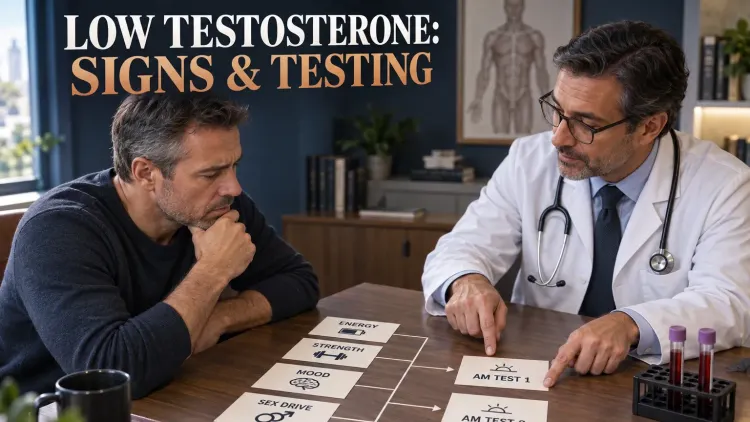
Signs of low testosterone: what they mean and when to get tested
The signs of low testosterone in men, why they are easy to misread, and how the diagnosis is confirmed. Test before you assume.