TRT explained honestly: who it helps, what it costs, what to ask
Testosterone replacement is a real treatment for a real diagnosis. What the trials show it does and does not fix, the trade-offs, and how to spot a bad clinic.


Testosterone replacement therapy is a legitimate treatment for a specific diagnosis. It is also the product an entire online industry sells to men who do not have that diagnosis, in language borrowed from performance marketing, not medicine.
Both things are true at once, which is why this guide separates them. Here is what TRT does when it is the right treatment, what the largest trials show it does not do, what it costs you beyond money, and how to tell a careful clinic from a subscription mill.
Who it is actually for
The entry requirement is not a feeling. It requires compatible symptoms or signs plus consistently low testosterone on two separate early-morning tests. The fasting detail depends on the guideline: the AUA specifies early-morning measurements, while the Endocrine Society and EAU specify morning fasting samples.
The AUA uses total testosterone below 300 ng/dL as a reasonable cut-off supporting the diagnosis, but the number is not a diagnosis by itself. Diagnosis requires compatible symptoms or signs and two separate early-morning measurements (AUA guideline). The Endocrine Society does not use one cutoff independently of the assay and clinical picture. It requires unequivocally and consistently low concentrations measured with an accurate assay and interpreted against an appropriate reference range (JCEM, 2018); its July 2026 statement describes a common clinical threshold near 300 ng/dL (Endocrine Society, 2026). Its 2026 statement doubles down on repeat early-morning fasting testing, and on looking for reversible contributors before anyone writes a prescription (Endocrine Society, 2026).
If you haven't done that groundwork yet, start there, not here. Both halves have their own guides: signs of low testosterone for the symptoms, the testosterone blood test for the measurement.
What the guidelines actually say, and where they disagree
There is no world number for a low testosterone level. Four bodies publish one, they do not match, and the gap between them is wide enough to change your diagnosis. All four were read against their current text on 9 September 2026.
| Body | Where it applies | Current version | A result counts as low at | Confirmation it requires | When it says to treat |
|---|---|---|---|---|---|
| AUA | United States | 2018, validity confirmed 2024 | Below 300 ng/dL (10.4 nmol/L), called a reasonable cut-off rather than a boundary | Two total testosterone measurements, both early morning | Symptoms or signs plus the low result. PSA first in men over 40. The amended 2024 AUA/ASRM infertility guideline says not to prescribe exogenous testosterone to men interested in current or future fertility. |
| Endocrine Society | United States, widely cited elsewhere | 2018 guideline, plus a 2026 statement | No universal number. Unequivocally and consistently low, read against the assay's own range | Fasting morning total testosterone on an accurate assay, repeated. Free testosterone by equilibrium dialysis when the total sits near the lower limit or SHBG is altered | Symptoms and signs plus consistently low results, after reversible causes are looked for |
| EAU | Europe | Current edition | Below 12 nmol/L (3.5 ng/mL), a strong recommendation | Morning sample between 07:00 and 10:00, fasting, repeated at least twice when below 12 | Symptomatic men below 12 nmol/L without contraindications |
| BSSM | United Kingdom | 2023 | Above 12 nmol/L does not require therapy; 8 to 14 nmol/L is a judgement zone | Two separate samples taken between 8 and 11 am, with free testosterone in the borderline band | A trial of at least six months in the 8 to 14 band, decided on symptoms; treatment is also supported below 14 nmol/L in symptomatic men with pre-diabetes |
Read the first two rows together and the practical problem appears. A man who measures 330 ng/dL has a normal result under the AUA cut-off and a low one under the EAU threshold, because 12 nmol/L is about 346 ng/dL. Same blood, same day, different verdict depending on which side of the Atlantic his clinic takes its guidance from.
Three things follow from that table.
Ask which threshold your clinician is using, and whether your laboratory's own reference range says something different again. Assays are not interchangeable, which is the reason the Endocrine Society does not treat one number as a universal boundary.
Nobody treats a number on its own. All four require symptoms or signs, and all four require the low result to be repeated on a second morning. A clinic that offers treatment after one afternoon sample is not following any of them.
The borderline band is where guidance turns into judgement. Between 8 and 14 nmol/L, which is about 231 to 404 ng/dL, BSSM allows a six-month trial decided on symptoms while the AUA cut-off would call most of that range normal. If your result lands there, that is the conversation to have, and the honest answer is that the evidence does not settle it for you.
What it does well, and what it does not
The clearest read comes from the Testosterone Trials: 790 men aged 65 and over, all with levels under 275 ng/dL and symptoms, randomized to testosterone gel or placebo for a year (NEJM, 2016).
| What men hope for | What the trial found |
|---|---|
| Sex drive and erections | Improved: more sexual activity, more desire, better erectile function |
| Mood | Slightly better mood and fewer depressive symptoms |
| Energy and vitality | The primary FACIT-Fatigue outcome showed no statistically significant improvement; secondary vitality measures showed small improvements. |
| Physical function | Walking distance improved marginally, 20.5% versus 12.6% across all participants |
Read the middle two rows again, because they are the ones the advertising inverts. These men were genuinely deficient and were treated up to the mid-normal range of a young man, and the primary FACIT-Fatigue responder outcome still showed no statistically significant improvement, although secondary SF-36 vitality and self-reported energy measures showed small gains. So if tiredness is your main complaint, take that as a cue to hunt for other causes before betting on TRT; our guide to persistent tiredness lists the ones to chase first.
What we now know about the heart
For a decade this was the open question, and it kept sensible men off treatment they needed.
TRAVERSE randomized 5,246 men aged 45 to 80 who had existing cardiovascular disease or high risk for it, all with symptoms and two fasting testosterone levels under 300 ng/dL, to testosterone gel or placebo, with a mean follow-up of 33 months. Heart attack, stroke or cardiovascular death occurred in 7.0% of the testosterone group and 7.3% of the placebo group, a hazard ratio of 0.96. Testosterone was noninferior to placebo (NEJM, 2023).
That is reassuring, and it is not a clean bill of health. The same trial found more atrial fibrillation, more acute kidney injury and more pulmonary embolism in the testosterone group. So the honest summary reads: in men like those enrolled, middle-aged and older with confirmed hypogonadism and raised cardiovascular risk, TRT did not raise the trial's primary composite risk of cardiovascular death, heart attack or stroke, and it was not risk-free either. Long-term safety, including prostate cancer risk, remains incompletely established on the Endocrine Society's own reading (Endocrine Society, 2026). And none of this evidence applies to men with normal levels taking it to feel younger.
The US label changed after that evidence. In February 2025, FDA removed class-wide boxed-warning language about increased cardiovascular outcomes after reviewing TRAVERSE and required warnings that testosterone products can raise blood pressure. In June 2026 FDA asked manufacturers to update the prescribing information again: to remove the limitation stating that safety and effectiveness for age-related hypogonadism had not been established, and to revise the prostate cancer and benign prostatic hyperplasia safety information. Those are requested changes to the label, not a finding that testosterone treats aging. These label changes do not make TRT an anti-aging treatment or support treatment when testosterone is normal.
The costs nobody puts in the advert
Financial cost. It depends on the formulation, insurance and what a clinic bundles. Before enrolling, ask for the separate price of the medication, initial and repeat laboratory tests, clinician visits, injection supplies if relevant, shipping and cancellation. A low monthly headline is not comparable with a plan that includes proper monitoring, so this guide does not quote one national monthly figure.
Fertility. Testosterone from outside switches off the signal that drives sperm production. The AUA/ASRM male-infertility guideline, amended in 2024, says exogenous testosterone should not be prescribed to a man interested in current or future fertility. Fertility-preserving alternatives exist for selected men, but that decision belongs with a reproductive urologist or fertility specialist. If you have already started TRT, it is not necessarily too late, but recovery after stopping is variable, can take many months or longer, and is not guaranteed; speak with a reproductive urologist or fertility specialist before trying to conceive or changing treatment.
Thicker blood. Testosterone raises red cell production, so hemoglobin and hematocrit are measured before starting and monitored during treatment. Under the AUA guideline, a baseline hematocrit above 50% should be investigated before treatment is started or continued, and a hematocrit of 54% or higher during treatment warrants clinician-led intervention, such as dose adjustment or temporary discontinuation.
The prostate check. Under AUA guidance, PSA is measured in men over 40 before testosterone treatment; other guidelines individualize prostate assessment by age and risk.
It can become a long-term commitment. TRT suppresses your body's own testosterone and sperm production while you take it. Whether you can ever stop depends partly on why your level was low in the first place, and if you do stop, your own production may take time to come back. Starting is a bigger decision than "let's see how you feel for a month."
What careful treatment looks like
Before you start, expect two separate early-morning testosterone tests. Whether both should be fasting depends on the guideline and local protocol: the Endocrine Society and EAU specify fasting, while the AUA statement specifies early morning without adding a fasting requirement. The work-up also includes luteinizing hormone to establish where the problem sits, prolactin if LH is low or low-normal, hemoglobin and hematocrit, blood pressure, and prostate/PSA assessment appropriate to the guideline, your age and your risk. A careful prescriber also checks for reasons not to start, or to delay: fertility plans, a raised hematocrit, untreated severe sleep apnea, relevant prostate or breast cancer concerns, uncontrolled heart failure, a cardiac event in the past six months, or thrombophilia.
Once you are on it, dosing aims at the middle of the normal range, not the top. Urology guidance puts the target in the middle tertile of the reference range, roughly 450 to 600 ng/dL for most laboratories. Higher is not the treatment goal, and it may buy you adverse effects instead of benefits.
Then come repeat checks of testosterone, hematocrit, blood pressure and PSA on a schedule your clinician sets, together with an honest review of whether the symptom that justified treatment has improved. If testosterone reaches the target range but that symptom has not improved, the AUA says clinician and patient should discuss stopping treatment after three to six months rather than continuing an ineffective prescription.

Six questions to ask before you start
- What were my two morning testosterone results, and what was my LH? If the answer involves one afternoon test, stop.
- What symptom are we treating, and how will we know it worked? Name it up front.
- What is my baseline hematocrit, and what prostate assessment is appropriate for my age and risk? No baseline means no monitoring.
- Do I want children in future? Planning before treatment gives you more options; if TRT has already started, ask promptly about fertility assessment and specialist management.
- What happens if I stop? Ask what recovery might look like in your situation and whether the underlying cause is reversible. A clinic that glosses over this is selling, not treating.
- Have we ruled out the reversible causes? Weight, sleep apnea, alcohol and medications all lower testosterone, and our guide to raising testosterone naturally puts numbers on each.
How to spot a bad clinic
- It treats a level that is not low, or one measured once, in the afternoon.
- It never mentions fertility, hematocrit or PSA.
- It talks about "optimizing" you into the top of the range, or above it.
- It bundles the prescription with supplements. Our review of testosterone boosters explains what those are worth.
- Nobody asks why your testosterone is low. Cleveland Clinic lists obesity, sleep apnea, opioids, alcohol and pituitary problems among the causes (Cleveland Clinic), several of which are treatable in their own right, no prescription required.
TRT changes lives for men who genuinely have testosterone deficiency. For everyone else it is an expensive, hard-to-reverse way to treat a problem they do not have. The blood test is what tells the two apart, and it costs a fraction of a year's prescriptions.
Correction, 14 September 2026: an earlier version said FDA's June 2026 request had already removed the age-related hypogonadism limitation from testosterone labels. FDA asked manufacturers to make that change; the text now says so. The change is recorded on our corrections page.
Frequently asked questions
Who is testosterone replacement therapy actually for?
Men who have compatible symptoms or signs and consistently low testosterone on two separate early-morning blood tests; some guidelines, including the Endocrine Society’s, specify fasting samples. The AUA uses total testosterone below 300 ng/dL as a reasonable supporting cut-off, while the Endocrine Society interprets a low result with the assay, reference range and clinical picture. Treating a normal level is not TRT.
What does TRT actually improve?
The best evidence comes from a year-long trial in men aged 65 and over with genuinely low levels. Testosterone improved sexual activity, desire and erectile function, and mood improved a little. The primary fatigue outcome showed no statistically significant improvement, although some secondary vitality and self-reported energy measures showed small gains. The effect on walking distance was marginal.
Is TRT bad for your heart?
In TRAVERSE, rates of cardiovascular death, heart attack or stroke were similar with testosterone and placebo among middle-aged and older men with confirmed hypogonadism and raised cardiovascular risk. Atrial fibrillation, acute kidney injury and pulmonary embolism occurred more often with testosterone. FDA removed class-wide boxed-warning language about increased cardiovascular outcomes in 2025, required blood-pressure warnings, and requested further prescribing-information updates in June 2026. Long-term safety is not fully established.
Does TRT make you infertile?
It can markedly suppress sperm production. The AUA/ASRM guideline says exogenous testosterone should not be prescribed to a man interested in current or future fertility; selected men may have fertility-preserving alternatives to discuss with a specialist. If TRT has already started, recovery after stopping is variable, can take many months or longer, and is not guaranteed.
Do you have to stay on TRT for life?
Not always, but plan as if you might. External testosterone suppresses your own production while you use it. After stopping, recovery is variable and depends partly on why your level was low; some causes are reversible, while primary testicular or structural pituitary disease may not recover. Discuss any change with your prescriber rather than assuming your own production will restart on a set timeline. It is a commitment, not a casual experiment.
How do you tell a bad TRT clinic from a careful one?
Watch what they measure and what they skip. One afternoon test, a "low" level that isn't actually low, no mention of fertility, hematocrit or PSA, talk of "optimizing" you into the top of the range, supplements bundled with the prescription, and no curiosity about why your testosterone is low. Any of these tells you the business model before the doctor does.
Read next
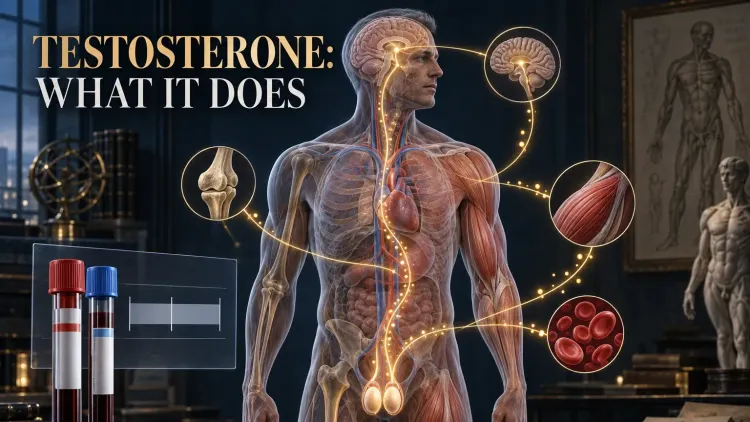
Testosterone: what it does, what is normal, and what really changes with age
Testosterone results need context. Learn what the hormone does, how total and free levels differ, what ranges mean and when repeat testing is useful.

How to raise testosterone naturally: what the evidence supports
How to confirm low testosterone and address weight, sleep, alcohol, medicines and deficiencies without relying on unsupported booster claims.
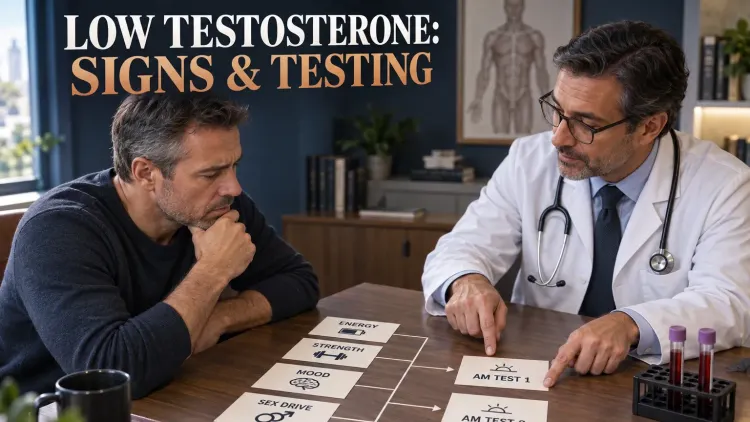
Signs of low testosterone: what they mean and when to get tested
The signs of low testosterone in men, why they are easy to misread, and how the diagnosis is confirmed. Test before you assume.